When my novel Heather Girl is made into a major motion picture starring Amy Adams, this is the song that will play as the opening credits roll and Heather walks down the street to the coffee shop, the wind whipping through her hair. Credit to my cousin, Joe Clatworthy, who wrote the song and recorded it as a member of the group The Muffetts, though they were also known as The Mojos.

I didn’t want to hit him.
I had nothing against him. No malice, no hard feelings of any kind. He had done me no harm.
It surprised me when he took that first swing. His eyes wild, hopped up on something, sweat running down his forehead and into his eyes.
I leaned back a little, dipped to the right and easily dodged his looping attempt to take my head off.
It surprised me even more how quickly he took his second swing, this one coming from his left. It caught me in the neck and knocked me back. It didn’t hurt, but I knew right then I’d have to hit him.
He kept coming at me, wailing away as I covered my head, his punches landing on my arms. Then he stopped.
I peaked out between my arms and saw him standing there, his hands by his side, gasping for air. Some of the crazy had left his eyes. Sweating more than ever. I was hoping he’d just quit.
I dropped my hands. He picked his up and came at me again.
I was ready this time and started to move around the ring, slipping and dodging punches. I was pretty sure he wasn’t going to be able to hit me anymore. There was no way he was going to hurt me. But I also knew that because I hadn’t even thrown a punch, he was ahead on points.
I tossed out a gentle jab, tapped him on the forehead. He threw a wild right. Another jab, square in his face. And another.
Then he charged me. No pretense of boxing, just an all-out street fight. I tried to fend him off, but he ran right through my gloves and into my chest. He grabbed me in a bear hug and tried to wrestle me to the canvas, and in the process, he head-butted me and busted my lip.
So much for a fair fight.
I stepped to my left and swung my torso while I pushed him in the same direction. He stumbled away and almost fell out of the ring. My eyes were watering from the head-butt but I could see clearly enough. He got to his feet and glared at me, readying himself for another charge.
Before he could take a step, I stung him with a jab. A real jab this time, not just a friendly tap on the noggin. It stopped him dead in his tracks. Another one and he wobbled a bit. One more, with feeling.
And he was down.
.
I already knew what I was going to tell Kari. In fact, the lie had already been started.
I told her they needed me to work the second shift, which actually happens now and then. Of course I wasn’t working the second shift, or the first shift, or the hoot owl, for that matter. I wasn’t working any shift. Demand was down, so production slowed and they had to let some of us go. And not just at Maysel No. 2. All the mines were down. So it wasn’t like I could just go somewhere else.
But I was doing what I could. I managed to get a few hours at the prep plant down in Boomer. Even filled in for workers on a road crew in Mingo. But work’s hard to come by right now.
I was hoping I might come out of the fight unscathed, but I had a lie ready for that, too. It’s dark in the mine and it’s not at all unusual to get a few bumps and bruises. A busted lip is a little different, but I could sell it. To Kari, anyway. I was hoping I wouldn’t have to lie to the kids.
She bought it. I think. She didn’t ask any questions when I told her I was off to work the next evening. She even packed my lunch pail.
.
That first night had been like a wild carnival, but those first round fights eliminate most of the drug-crazed loonies. But it was Saturday night and like the old song says, Saturday night’s all right for fighting and there was still enough crazy to go around.
Back in the locker room the handler slipped my gloves on and started to lace them up. The card said I was up against a guy from McDowell County. I asked the handler if he knew him and he nodded toward the guy at the other end of the room. He was already laced up and shadowboxing in front of the mirror.
I knew then that there was a real possibility that I might not make it to the money round.
Not that I didn’t know what I was doing. I learned from my grandfather. Learned about footwork. Learned how to use leverage to throw a punch. Timing with combinations. Defense. And reading an opponent. But that was a long time ago. Gramps had been dead four years now, but it had been even longer – fifteen years, maybe – since I used the skills he taught me.
Gramps fought until he was in his late thirties, just a little older than I am now. He was good. Black Dynamite, they called him. Never made much money. Never could fight his way out of the hollers.
He taught me because he knew I’d need to know how to fight. I wasn’t quite black, which would have brought it’s own challenges, but I wasn’t white either. Got just enough of my mother’s fair skin and my daddy’s brown to put me in my own class of outcast. Half-breed, they called me.
Gramps started training me early and when I turned sixteen, he signed me up for Golden Gloves in Charleston. I did ok, but more importantly, word got out that I was a fighter. Once I survived a couple of challenges by rednecks who just had to see for themselves, everybody left me alone.
.
Turns out the guy from McDowell is more style than substance. We both start out deliberately, because we both think we’re boxers. Proper stance and footwork, moving around the ring in slow circles. He throws a soft jab, not really meaning to hit me, just trying to get things started. He throws another one and his right hand is already dropping. He’s an easy target. He tosses another soft jab. I can see he’s scared. In over his head.
I sting him with a jab and his eyes water up. Another jab and he rocks backward and covers up. I give him a chance to get his head together. Then he tries another jab, this one with a little more velocity, but not nearly enough. I come in over his his right hand with a left hook and it’s all over.
I hear the crowd. A collective ooh. I walk back to my corner, my head down.
I’m in the money round.
.
Gramps killed a man in the ring.
He told me about it after I had quit fighting. Boxing’s supposed to be a sport, but it can get you killed. All it takes is one punch.
I don’t want to have to live with that.
I want this night over. Never again.
.
My next fight was an hour later. If I win, it’s worth $500. That’s why I’m here.
This time I don’t ask about my opponent. I know he’ll be tough. You don’t get to the third round without knowing what you’re doing. I see him for the first time when I step into the ring. He’s at least two inches taller than I am.
Now I’m the one who’s scared.
This fight starts like the last one. Circling, jabbing, but when he throws a jab, he’s not tentative. He’s meaning to hurt me. I slip the first two but the third catches me on the side of the face. I throw a couple of my own but they don’t connect. He throws two more then follows with a right, which I barely duck. I felt the leather skin across the top of my head and I know I’m going to have a burn.
He peppers me with more jabs, each one coming closer to a square hit. He tries the combination again but I’m ready for it this time and have no problem avoiding it. But I can’t get through his gloves. My jabs just meet leather. I try a right cross with the same result.
He flicks another jab. This one on the mouth. He breaks open the cut from last night. I had told Kari that John Boy had poked me with the wrong end of a shovel. I could tell she didn’t believe me. She sure won’t believe John Boy poked me again.
This is not going to end well.
I didn’t see him load up his right hand and it catches me square on the side of my face. The next thing I know I’m looking up at the ref, who’s looking down at me counting. He reaches six and I start to get up and I hear the bell.
I make it to the corner and reach for a towel. Not to wipe my sweat, but to throw it to the ref. I’m outmatched and I could get hurt, really hurt. And if I get hurt, I can’t work.
The second hands me a water bottle.
Go to the body, he says. His hands are so high, you can pound his body all night.
How did I not see that? I wipe my face with the towel.
The bell rings and he thinks he has me. More jabs, which I knew were coming. And the right. This time I go under and step forward. A right to his gut. Then a left and another right. I hear him grunting, trying to push me away. I step back, throw a couple of jabs, then here he comes again.
I step inside and start pounding. He cusses and I know I’m hurting him. I get maybe five or six really good punches before he pushes me away again. Now he’s mad.
Before I can get set he catches me again with another right and down I go. But I don’t feel it like I felt the first one. I’m back on me feet at three. The ref dusts my gloves and I wait for the barrage.
Here it comes. Jab. Jab. Right.
Again I duck under and go to work. His elbows drop to his side and I move toward the center of his stomach. His sweat is dripping all over me, but I keep hitting before he finally clinches and holds my arms.
The ref breaks us up and I step back. His arms are down. He doesn’t want me to hit him in the gut anymore. And I know he can’t throw his jab with his arms down.
I fake a punch to his stomach and he covers up. I launch a left hook. Then a right cross. He’s reeling and I follow up with a perfectly leveraged left hook to the head. The best punch I’ve ever thrown in my life.
And he’s down. He’s not moving. Out cold.
I’m caught up in the sport of boxing, enjoying the moment of victory, the successful strategy, the physical triumph. The crowd is roaring. It feels good. No, it feels great.
He still hasn’t moved.
The referee is kneeling beside him. The ring doctor is there, too. Someone is fanning him.
He still hasn’t moved.
I start to pray. I didn’t even know it at the time, but when I replay the scene in my mind, I was praying.
He still hasn’t moved.
How was I going to tell Kari? How was I ever going to be able to face my kids?
Then I see his eyes flicker, then open slowly. He looks around and they pull him up to a seated position. A couple of minutes later, he’s on his feet.
But that’s it. Five hundred is enough for Christmas presents. I forfeited the championship match.
.
I got home after midnight. Kari was waiting on the couch, the television on, the tree in corner, no presents underneath.
Junior called, she said.
Junior’s my boss.
Said to come back to the mine on Monday night if you want to work the hoot owl.
She knew all along. I could tell. She looked at my bruised face.
Did you win?
I pulled the envelope from my back pocket and handed it to her.
For you and the kids.
We got to do something else, Jimmy. We can’t live like this.
I nodded. There weren’t a lot of options. It wouldn’t be easy. But she was right.
I sat on the couch beside her and she leaned her head on my shoulder.
Somehow we’d figure it out.
copyright 2017, joseph e bird
Photo Credit: iStock
This from poet laureate of the Shelton College Review, Larry Ellis.
Psalm 57: 8
Awake up, my glory; awake psaltery and harp: I myself will awake early.
Think of David as he lies on the mountain
He looks at the night sky
Unending, unfathomable, unreachable
The diamond stars
The firmament that declares the glory of God
And he aches
His heart panting like the hart after the waterbrook
At his side are sword, spear and bow
His body is cut from oak, his skin like leather
His mind a blade itself, with razor’s edge
He breathes the open air and the day’s tension dissolves
He rests in the shadow of the wings of the Almighty
.
This man who killed the giant
And tens of thousands
Hears heaven’s choir and plays on his harp
Songs that soothe the savage breast of Saul
His poems are those very psalms
That have charmed and inspired
Over millennia
And he aches
.
At first light, at first rustling of dawn
He turns and shakes away sleep
Here is a new day
He rises, believing the promise
“Awake up, my glory”
.
What is his glory?
One more win in bloody combat?
Or is it that unknowable thing
That all men share with him
That desire beneath all desires
That lesser men have long since forgotten
And forfeited to the unrelenting fates
That lesser men are afraid to confess
.
Does David wake early
Expecting glory in bloodshed
Or does he crave
That his righteousness will shine like the dawn
And the justice of his cause like the noonday sun?
Does he crave that gift, that grace, that dispensation
That is his and his alone?
That unspeakable grace promised to him
When he first came to know himself?
.
Is the difference between him and me
That he believes it will happen
And maybe this very day
And so he wakes early
And takes in hand
Psaltery and harp
Copyright 2017, Larry Ellis
If you’re a runner, you know the feeling.
Every now and then, it all comes together. You’ve trained just enough, you’ve found just enough rest, your legs feel fresh, the weather is just right, and you’re running as if you’re weightless, moving fast and smooth, and as the miles click off, you never slow down and you wish you could run that way forever.
Not so much for me, lately, as I struggle to get back on the road.
Writing has a similar zone, one that I haven’t felt for a while. It’s been a rocky year and I’ve had difficulty in finding a rhythm. Just the ordinary trials of life that we all face. The week of Thanksgiving our furnace was out. It was so cold in the house I couldn’t put two words together. Then there’s work (the paying job) and work at home (the basement remodeling project) that have been conspiring against my mind and body.
But Sunday morning I found it. After a tenuous start, the words started to flow. Just enough training, just enough rest, my mind felt fresh, the room felt right, and I was writing as if I were weightless, so fast and smooth, and as the words clicked off, I never slowed down and I felt like I could write that way forever.
“The consolation of imaginary things
is not imaginary consolation.”
— Roger Scruton
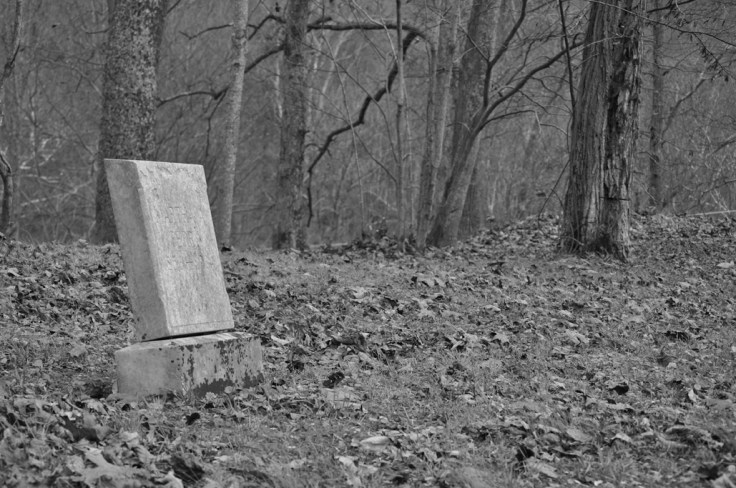
she wasn’t supposed to go there by herself.
up the steep gravel road,
through the woods
to the clearing
where the old grey headstones
were covered in moss
and leaned toward the earth
as if they were too tired
to stand up straight,
for so long they had stood in testament to
the forgotten lives
of those whose names were
were worn from the stone
by the unrelenting and unforgiving
passage of time.
she wasn’t supposed to go there by herself.
because there were snakes
and yellow jackets
and maybe bears
and at night
across the hollows
voices and laughter and music
and now and then
a gunshot
would echo
from neighbors unknown,
and though the graveyard
was close
it was no place for
a little girl alone.
she wasn’t supposed to go there by herself.
but with the grey, rough tablets
of ancient men
and their wives
and their children,
were smooth slabs
of curved and polished marble
with praying hands
and crosses
and Bible verses
written in script,
and names her grandmother knew
of this cousin and that uncle,
and her grandmother’s husband,
the grandfather she had never known.
she wasn’t supposed to go there by herself.
under the deep shade
cast by towering oaks and maples
where grass wouldn’t grow
and moss and lichens
clung easily to the old stones
and left her grandfather’s grave
untouched by nature,
save for the pollen in the spring
that she would wipe with her finger
from the smooth headstone,
that also promised
that her grandmother would
someday
rest with him.
she wasn’t supposed to go there by herself.
but her grandmother worried too much,
she had never seen a snake
and stayed clear of the bees
and the idea of bears
just seemed silly,
and it was peaceful
always peaceful
and she would talk to God
and ask why other kids
teased her,
though she knew
it was because her clothes
were old and
she was poor.
she wasn’t supposed to go there by herself.
and she sat beside the grandfather
she knew only from photographs,
and read Psalms
from his old Bible
and drew wisdom from the words
that would stay with her
all of her days,
and give her
comfort
through her pain,
and strength
through her weakness,
and courage
through her fears.
she wasn’t supposed to go there by herself.
and when she saw him
she knew her grandmother
had been right,
and she had been foolish,
and as he came toward her
he took a drink
from a bottle
and wiped his mouth
on his sleeve
and laughed,
and she knew
that he had come
from the valley
of the shadow of death.
she wasn’t supposed to go there by herself.
but she would fear no evil
and she always carried a staff,
for walking, she thought,
the iron pipe
from her grandfather’s workshop,
and she stood
and gripped it in both hands
and drew back
and stepped toward him
and swung,
and he screamed as it struck
against his ribs,
and his bottle dropped,
and she ran off the hill.
she wasn’t supposed to go there by herself.
she didn’t tell her grandmother
and she didn’t sleep
for days,
and when the kids
teased her because
she had to tape the soles
of her shoes,
and because she lived
in a shack with her grandmother
because her mother had
killed herself with a needle,
she cried into her pillow
softly,
so her grandmother wouldn’t hear.
she wasn’t supposed to go there by herself.
and it was weeks before she went back
to find her staff,
her grandfather’s iron pipe,
which had given her protection,
and to find the peace
that had left her.
but it wasn’t the same.
she couldn’t read
she couldn’t pray
she couldn’t close
her eyes
because he might
be out there
still.
she wasn’t supposed to go there by herself.
and though she was afraid,
she still went there by herself,
because it was there
she learned of
comfort and strength and courage.
and she would grow
and live far away
from the hollows,
and the kids who teased her,
and she would become a woman
strong in her will and
strong in her faith
and when she was alone
she went there by herself.
copyright 2017, joseph e bird
photo copyright 2017, joseph e bird

tomorrow will come, and i’ll sing an old song
and think of the day, that the words came along
i didn’t know then, that song was my last
i didn’t know then, that time flies so fast
tomorrow will come, and i’ll look toward the sun
and remember the spring, when i went for a run
i didn’t know then, that it was my last
i didn’t know then, that time flies so fast.
so remember the day, of all that was good
when youth was forever, we’d play when we would
remember the day, of life with no fears
tomorrow is coming, and with it the tears
.
tomorrow will come, and i’ll think of my friend
and read all the words, that he took time to send
i didn’t know then, that they were his last
i didn’t know then, that time flies so fast
tomorrow will come, and i’ll hear her sweet voice
and laugh at her jokes, her spirit rejoice
i didn’t know then, that her smile was her last
i didn’t know then, that time flies so fast
so remember the day, of our one last good time
when I touched your face, and your hand held mine
remember the day, and when we would dance
for tomorrow is coming, leave nothing to chance
copyright 2017, joseph e bird
She stood for a moment, taking it in, but her father brushed beside her, flipped on the light, and went over to the workbench where all of his tools used to be, where the greasy parts would sit for weeks at a time until the project was finished or until he would finally toss them into one of the wooden bins under the bench, even the parts that were no good, because you never knew when you might need to scavenge a part from a part, or look at the old part to see how the new part is supposed to go together, or, more likely closer to the truth, the parts had become too personal, had served so long and so well, that they deserved a fate more fitting than a trip to the dump in a trash truck with the rotting lettuce and soiled diapers, and so they were dropped into the wooden bin with a dull clunk, where they would be with their own kind, a camaraderie of the tough, the loyal, and the broken down, who, by the weight of their own existence in the hand of a knowing mechanic, would still have value in some as yet unknown way.
copyright 2017, joseph e bird, from the novel Heather Girl.

Halloween’s never been my thing. With all the genuine evil in the world, do we really need to be celebrating the dark side? I’ll pass on the make-believe macabre, the bed-sheet ghosts, and ouija board spirits. Who needs that when you have real hauntings? It’s a rhetorical question, of course. One that I wish I didn’t have to consider. But it’s not my choice.
It’s been five years now. Three since I moved to Arizona.
We lived in Ohio at the time, Carolyn and I. Chillicothe. We’d been married for a couple of years and life was good. You know, the honeymoon that never ends. We were a good match. I’m a practical guy. Sensible. Reasonable. Just this side of boring. Maybe not even this side. Carolyn was anything but. Everyone loved Carolyn. She was a real free spirit. I loved that about her.
It was fall. For me, that meant football. I would have been happy staying home watching games all weekend, but Carolyn was restless and wanted to get out. She needed a change of scenery, away from the unrelenting flat land of Ohio. The mountains, she said. The leaves would be at their peak and the weather promised to be nearly perfect, with just a slight chance of rain. I never could resist her enthusiasm. We got up early on Saturday morning, threw a change of clothes in a duffel bag and headed across the border to West Virginia.
We drove for hours, stopping now and then at scenic overlooks, taking pictures of everything. We got to one of the state parks around noon and had lunch in the lodge, then walked it off with a hike to the falls. There was another park about three hours away and we thought that would be a good place to spend the night, so we jumped in the car and headed west, chasing the sunset, as it were.
We never made it to the park.
River Mills. Such a nice sounding town. Carolyn had been reading the tourist flyers while I drove and she thought she remembered reading something about the town. A restaurant, maybe. She flipped through her stack of flyers, looking for the one that mentioned River Mills, but she never found it. Or course she wanted to stop anyway. I wanted to go on. I was beat. A lumpy state park mattress was calling my name. But it was Carolyn. Her persuasion was hard to resist.
We got off the four-lane and as we drove the seven miles on the winding highway toward River Mills, the sun hid behind thickening clouds and after a few minutes, a light rain began to fall. A mist rose from the warm asphalt.
A worn, wooden sign welcomed us to River Mills. We passed a gas station, closed since forever. Not a convenience store, an honest-to-goodness gas station with a two-bay garage and a glassed-in office where the owner would sell tires and ring up the sale on a cash register and the old men of River Mills would gather and gossip worse than the women ever did. The windows were broken. The gas pumps were gone.
Then another dilapidated building. More busted windows. Faded white paint on red brick spelled out River Mills Hardware. I began to calculate how long it would take us to backtrack and get to the park.
Just a little farther, Carolyn suggested. I didn’t argue.
Up ahead I saw a traffic light. I took that as a good sign. That traffic light is gone now. At least it was the last time I was in River Mills. That was four years ago.
The streets were empty. Not completely empty, but there was a uneasy quiet about the place. Most of the storefronts were vacant. Some of the buildings had been gutted, stripped of walls, floors and even the roof, so that all that was left was the facade and the back wall. We drove past a second-hand shop that might have still been in business, but it was hard to tell for sure. Another store had mannequins clothed in old wedding dresses. There was no sign out front, no name on the glass, nothing to indicate what that was all about.

We drove on. Carolyn was sure there was a place to eat. Another two blocks and we came to what looked like an old courthouse. Closed, of course. It was nearing six o’clock, after all, and there was no sign of life anywhere.
And then this.
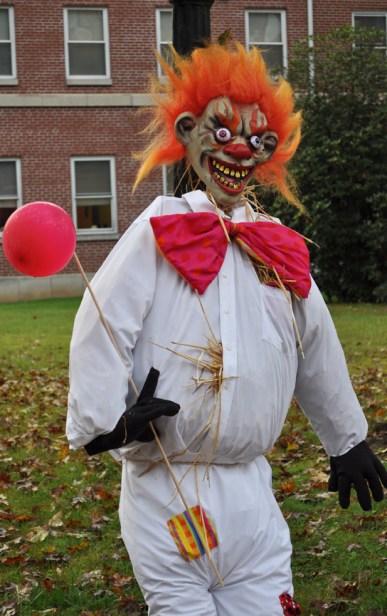
Yeah, Halloween was a couple of weeks away, but this seemed a little over the top for a small town. A little too scary. We both forced a laugh.
They really get into the spirit here, Carolyn said.
Looking back, I think that spirit had always been there. And I know it still is.
The town completely creeped me out. I think Carolyn was feeling the same thing, and just as I was about to suggest that we go on to the park, she saw what she had been looking for. The River Mills Cafe. The lights were on. There were people inside. So Carolyn was right again. Except this time she wasn’t.
We parked out front and went inside. Helen greeted us and showed us to a table. I didn’t know Helen’s name at the time, but I found out later. Helen King. She wore an old-fashioned, yellow shift dress. She smiled as she seated us and then winked at me. She asked us what we’d like to drink. Coffee for me. Carolyn asked if they had hot tea.
Sure thing, honey.
She touched Carolyn’s shoulder. Her hand lingered. Then she left and Carolyn gave me a look that acknowledged the weirdness.
She winked at me.
She winked at you? What does that mean?
I was going to ask you.
I’ve got to find a bathroom.
She left. Helen brought my coffee.
Where’s Carolyn? she asked.
How do you know her name?
You said, tea for you, Carolyn?
But I hadn’t. At least I didn’t think I had. Maybe I did.
She left and returned with a small porcelain tea pot, a matching cup, and a box of assorted teas. I remember these things distinctly. Ordering hot tea at small diners can be surprising. So I noted the tea pot, the cup, and the box of teas. I remember thinking that Carolyn would be pleased.
Carolyn returned and smiled at the arrangement set at her place. Maybe this would be ok.
I excused myself for my turn to the bathroom.
Hurry back.
I thought nothing of those words at the time. Now I think of them every day.
Hurry back.
After I washed my hands, I looked at myself in the mirror, knowing I was little tired, but thinking I might be able run my fingers through my hair, maybe freshen up a bit for Carolyn’s sake. My reflection was hazy, as if the mist from outside had somehow settled on the glass of the mirror. I pulled a paper towel from the roll on the wall and wiped the glass, but the haze was still there. I tossed the paper in the trash and headed back to the dining room. The haze came with me. I could barely make out Helen standing behind the counter. I stopped and rubbed my eyes and blinked hard. Helen gave me a strange smile. I half expected her to wink again. The haze was slowly clearing from my eyes, but there was soft edge around Helen. A soft, fading edge.
I made my way back to our table. Carolyn wasn’t there.
I looked around. Maybe she went back to the bathroom. Or maybe she saw a gift shop and wanted to check it out. I sat at our table and took a drink of coffee.
The tea was gone. The tea pot, the cup, and the little box of teas. All gone.
Are you ready to order? It was Helen.
Where did Carolyn go?
Who?
Carolyn. My wife.
I’m sorry?
What are you talking about? She was here with me. You brought her hot tea.
Hot tea?
With the tea pot and tea cup.
Helen took a step back. We don’t have hot tea here.
I looked around, knowing that I’d see her. She had to be there. Then I noticed the others were gone, too.
Where’d everybody go?
Everybody?
The other customers. My wife. Where is everybody?
It’s been a little slow today. You’re our only customer this evening.
She must be in the bathroom.
I got up, almost running to the bathroom. I banged on the door and it swung open.
Carolyn?
No answer. I checked the stalls. Nothing. I went back to the dining room.
Where is she? Where is she?
Through the door to the kitchen. An old lady stood over a pot on the stove, stirring. There was no one else. Back to the dining room.
Where is she? My heart was racing.
I went out to the car. There was no sign of her.
Back to the dining room. Helen stood, her arms crossed.
Sir, you came in alone. I would have noticed if someone else was with you.
Why are you doing this? Is there a gift shop close by?
I didn’t wait for an answer. Up and down the streets I ran, looking for some place she might have gone. When I got back to the cafe, a deputy sheriff was waiting for me.
What seems to be the problem, son?
He didn’t believe my story.
I gave him my I.D. and showed him our duffel bag in the car. The flyers. Told him about our trip. How she insisted on stopping in River Mills. He looked me up in the system and confirmed that I was married. But my wife was missing. Last seen by anyone but me a hundred miles away. And just like that, I was a suspect in my wife’s disappearance.
The deputies looked all over River Mills but they were more interested in retracing where we had gone after we had left the park. I spent the night in a run-down motel just outside of town. The next day was more of the same. More searching, more questions, but no answers.
Another night and another day. Then another. Then another.
The deputies grilled me pretty good, but friends back home vouched for our relationship. I know the sheriff’s office thinks I killed Carolyn, but lacking a body, evidence, or a motive, they had no choice but to rule it a missing persons case. For them, a dead end.
I stayed two more nights.
She was gone.
I went back to Ohio, but called the sheriff’s office every day for two weeks. Not a trace, not a clue. I knew I would never see her again. I knew I would never know what happened.
It was a long, cold winter, the kind that keeps you inside and makes you think about things. I couldn’t just give up on her. After the first of the year, I went back to River Mills. I had to find something, anything, that would give me answers. Up and down the snow-covered roads. The town hadn’t changed a bit. The cafe was still open. I saw Helen through the window serving customers wearing that same yellow shift dress. I parked across the street and watched for a couple of hours. I stayed in River Mills all night, cruising the streets, in and out of town. As dawn broke, I found myself sitting on a bench overlooking the river that runs along the highway. Cold, tired, and utterly alone.
Back in Chillicothe, I tried to go back to living a normal life. Well, not normal. There was no such thing as normal anymore. But Carolyn’s words wouldn’t leave me alone.
Hurry back.
I could hear her voice.
Hurry back.
It was more than just something to say. There was tension in the way she had said it. The more I played her words back in my mind, the more I thought about it, the more I knew that it was fear in her voice.
Hurry back.
Did she know? Was it a premonition?
It was fall when I returned. The Halloween decorations were out again. Another scary clown stood staked in the courthouse lawn. And the stoplight was gone.
I spent all day and all night there. This time I talked to Helen. She stood with her arms crossed. Her answers to my questions were cold and unsympathetic. She wanted me gone. I searched the cafe as I had the year before and again found nothing. The old woman in the kitchen sat on a stool, her hands clasped in her lap, and just stared.
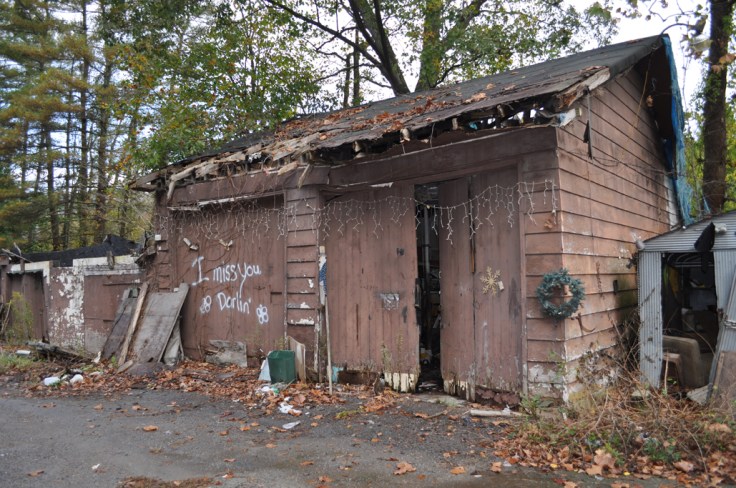
I spent the night in a motel in the next town over and the following day I made the rounds through River Mills again. And again, I found nothing. Heading out of town, I passed the same dilapidated buildings. The old hardware store. The gas station. The ramshackle shed that looked like it would fall with a strong gust of wind. I’d passed it probably dozens of times in the last year. But something was different. Graffiti on the side of the shack. Writing. I had gone by too fast to read it so I turned around and drove by again.
I miss you, Darlin’.
Carolyn.
My heart stopped.
It’s what she called me, sometimes. Darlin’. With the g dropped. Country style. Darlin’.
And the butterflies under the message. Her favorite doodle. Butterflies.
I pulled onto the gravel in front of the shed, almost hitting it with my car.
Carolyn!
I stuck my head in the door. It was dark and all I could see was trash and rotting timbers.
Carolyn!
I ran behind the shack, calling her name as I went.
I found a piece of pipe and went back to the front. I kicked the door open and with pipe in hand, made my way through the shack. A black snake hung from rafters. But that was the only sign of life.
I called the sheriff’s office and told the deputy that Carolyn was alive and that they needed to search the area out by the highway.
Just kids, he said. They paint their little love notes all over town.
But the butterflies.
Yeah. Butterflies.
I stayed three more days. I came back a month later and the message was gone. Not painted over, just gone.
Hurry back.
But I coudn’t. I just had to let it go. For the sake of my sanity.
No more River Mills. No more mountains. No more fall colors. No more hauntings.
But it hasn’t helped. I still hear her. In the still of the desert air, on the cool nights, with a million stars overhead, I still hear her.
Hurry back. I miss you Darlin’.
This story is a work of fiction. Names, characters, places, and incidents are either the product of the author’s imagination or are used fictitiously, and any resemblance to actual persons, living or dead, businesses, companies, events or locales is entirely coincidental.
copyright 2017, joseph e bird
 Joseph E Bird