Search

Joseph E Bird

Let's talk about reading, writing and the arts.

Tag

writing

missing

empty bench 2

He used to come by every couple of weeks.

My office has a back door to the alley, and every so often I’d hear the thump, thump, thump, and I knew it was Keith because no one else ever knocked on the door.  He lives in a high-rise in Dunbar, a couple of towns over.  He takes the bus to St. Albans, sometimes to Charleston.  You used to see him everywhere.  He’d show up at church on Sunday mornings, but never went inside to hear the sermon.  He’d stay out in the narthex with the ushers.  I sensed he never felt comfortable among the Sunday best.

When he’d show up during the week, I’d go to the back door when I heard his knock and we’d catch up for a couple of minutes.  He’d tell me about his daughter, who like him, battled addiction.  We’d talk about his counselor, Lisa, who seemed to be very good to him.  Helped him get through the everyday tasks of life, like keeping groceries in his apartment and making sure he had a good coat for the winter.

“What are you up to today?” I’d ask.

“I guess I’ll go back to Serenity Club,” was a common answer.  The Serenity Club, I gathered, was a safe place for those battling addiction to go and hang out.  Back near his high-rise.

I’d give him a couple of dollars for a cup of coffee and off he’d go.

Halfway down the alley he’d turn and yell, “Thank you, Joe.”  He was appreciative.

But he’s been missing.

I didn’t seem him through last winter.  Probably just staying in, I told myself.  Then spring became summer and I realized that I hadn’t heard his knock on the door for some time.  I began asking around.  Nobody had seen him.  He has relatives who go to our church but no one knew anything about him.

A few weeks ago I drove to Dunbar.  I knew where the Serenity Club was so I drove around the neighborhood looking for him.  Nothing.

This past Tuesday my wife and I were in Dunbar visiting an old neighbor in the nursing home.  We drove by the Serenity Club.  A man and a woman sat on a bench in the alley.  I parked the car and approached them.

“Is the Serenity Club around here?”  I asked, even though I was pretty sure of its location.

“You’re looking at it,” he answered as he thumbed to the building behind him.

“I’m looking for a friend who used to come here.  Keith.”  I told him his last name.

“Never heard of him.  What’s he look like?”

“In his 70s, I think.  Not too tall.”

“Doesn’t ring a bell.  How long ago was he here?”

I didn’t really know.  I told him I thought he had been coming for years.  Keith is not the kind of guy you easily forget.

We drove to the high-rise.  A half dozen people sat outside under the entry canopy.  I asked the same question.  I got puzzled looks in response.  Nobody knew Keith.  As if he had never existed.

I got back in the car and circled the lot.  As I turned the corner, I noticed a man walking down the sidewalk beside the high-rise.

“There he is!”

I stopped.  My wife got out.

“Keith!  Where have you been?” she says.

He stops.  He looks confused.  “Who are you?”

I’m thinking this isn’t a good sign.

“It’s Joe and Gloria.”

“Oh.  Hey.  What are you doing here?”  Turns out it was just the sun in his eyes keeping him from recognizing us.

I tell him the story.  That we’ve been looking for him.  Been missing him.  Told him I stopped by the Serenity Club but nobody knew Keith.

“Nobody knows me as Keith.  They know me as Harry.”

“Harry?”

“Keith is my middle name.  I go by Harry.”

All these years, I’ve called him Keith.  Everyone I know who knows him calls him Keith.  He’s never corrected us.  Even his relatives call him Keith.  And then I realize that those who really know him, those who live with him, those with whom he spends his days, call him Harry.

So we spend a few minutes catching up.  He fell sometime in the last year and busted his knee cap.  He seems to be completely recovered but he doesn’t travel around like he used to.  Just stays around the high-rise and the Serenity Club.

His daughter died.  I didn’t ask how, just assumed she finally lost her battle.  Keith is still winning his.  Twenty-three years coming up in a week or so.  His anniversary date is also his birthday.

He’s had a hard life.  The roller coaster, as he says.  It’s worn on him.  You can see it in his eyes.  But if you look closer, you can see the warmth, too.  There’s a kindness about him.

He introduces us to some of his friends at the high-rise.  Friends from church, he calls us.  We all have a laugh about the Keith-Harry confusion.  It’s clear they like Harry.  He seems happy and content.

We give him a few dollars to celebrate his upcoming anniversary/birthday.  We promise to come back and see him.  As we leave, Keith gives us a wave.  But he’s Harry now, back among those who know him best.

I could have been shot dead.

cigarette red glow for web

And that’s no exaggeration.  Bullets flew that night.  Things like that go bad all the time.

People die.

It could have been me.

*   *   *

Seems like every night it’s something else.

A loaf of bread.  A gallon of milk.  Something sweet.  Cookies, probably.  Chips Ahoy.

Not that I really mind.  Gets me away from the craziness of the apartment complex.  And I enjoy the walk.  It’s been cooler than usual for late summer in Houston.

Everybody’s out.  Either in the courtyard or on their balconies.  They’re always out.  Kids running everywhere.

Marvin and Shirley are sitting in their lawn chairs, their feet up on the railing.  I say hello and make my way to the steps at the other end of the balcony.  One of the twins sticks her head through the railing and watches, smiling.  Randy climbs over the rail and slides down the pole, then runs off across the courtyard.  Music is blaring from one of the apartments.  The Beatles, I think.  I never cared much about music.  But everybody’s crazy about the Beatles.

The 7-11’s just down the street.  Another couple of blocks away is the freeway.  I can hear the whine of tires on pavement.  It’s a busy neighborhood, but there’s never been much trouble.  At least not in the two years we’ve been here. I like Houston.  A lot different than the hills of West Virginia where I’m from, and where my family longs to return.  But I like it here.

I leave the apartment complex and walk down the sidewalk, the green and red sign of the store just ahead.  A kid on a motorcycle flies by.  He pops a wheelie.  Impudent snob. A man approaches.  He stops in front of me and I brace myself, not sure what’s about to happen.

“Hey, buddy.”

“Hey,” I say.  I don’t know this guy.  I don’t know why he calls me buddy.  We’ve never met.

“Got any spare change?”

Spare change?  Like change I don’t need?  Change I was just going to throw away when I got home?

He’s acting kind of squirrely.  I reach into my pocket and give him what I had in spare change.  Fifty some-odd cents.

“Thanks, brother.”

Brother?  Not hardly.  He heads on down the sidewalk.  I figure I’ll see him at the 7-11 in a few minutes buying beer.

There are a few cars in the parking lot.  Everybody needs something.  Everybody’s got to be somewhere.  At least that’s Duane’s line.

Duane lives down on the ground level of the apartments.  Always has a story to tell.  Like the time he was fooling around with another guy’s wife and the guy comes home unexpectedly.  Duane hides in the closet, but eventually the husband finds him, opens the closet door, and there’s Duane.

“What are you doing in the closet?”

“Everybody’s got to be somewhere.”

And then Duane laughs.  Laughs hard.  The story is made up, just for the punch line.  That’s Duane.

I pull open the door to the 7-11 and go inside.  I turn right, heading for the cooler where the milk is.

And then I see Duane.  Lying on the floor.  Flat out on his stomach.  Like he’s sighting something.  And he’s smoking a cigarette.

I’m just about to ask him what he’s doing when someone yells.

“Get down on the floor!”

I turn and look and see this guy.  He’s scruffy, week-old beard, long, stringy hair, eyes on fire.

He has a gun.  He points it at me.

You think I would have complied with his request, being the rational engineer that I am.  You think I would have immediately understood the situation, processed all of the information available, and joined Duane on the floor.

But, no.

For some reason my brain goes into lockdown.

“What?”

“I said get on the floor!”

He glares at me.

Ok. Yeah. On the floor.

“Hey, Duane.”

I didn’t actually say that. But we make eye contact.  Duane is still smoking his cigarette.

I still don’t know what’s going on.

“Open the safe!”  Same guy, yelling at the clerk.

Now I get it.  It’s a robbery.  A hold-up, as they used to say in the old black-and-white tv shows.  He could have just said that. It would have saved a lot of confusion.

This is a hold-up!

They should make that a rule.  Put it in the Handbook of Convenience Store Robbery: Best Practices for Hold-ups.

I hear the clerk answer.  “I can’t open the safe.”

Hmmm.  Not good.

“Open it!”

Then a ruckus.  I can’t see what’s going on.

Then three shots.

Bang! Bang! Bang!

You have no idea how loud a gun can be until you hear one fired inside a 7-11.
My ears are ringing.  And now I realize how bad this could be.  I picture the clerk bleeding on the floor.

Duane and I are next.

Shot in the back, execution style, the article in the Houston Post would read.

The cigarette falls from Duane’s mouth.  It’s lying on the floor, smoke trailing up in a soft swirl.  Duane’s scared. I can see it.

Another shot.

Did he just shoot someone else?

I hear something mechanical.  Ka-chunk, ka-chunk, ka-chunk.

“Dang it!”

For a robber, he sure uses polite expletives.

Then I see feet and legs running to the front of the store.  The robber, I’m guessing.  He bursts through the door, runs across the parking lot, and disappears down the street.

All is quiet.  So quiet.

I look back at Duane.  He’s completely pale.

“Is everybody ok?”

It’s the clerk.  I raise my head and look around.  I look up at the counter.

“He’s gone,” the clerk says.

By the time I get to my feet the clerk is on the phone calling the police.  Duane’s nowhere to be seen, his cigarette still smoking on the floor.  Everybody’s got to be somewhere.  Duane’s somewhere is somewhere else, apparently. Can’t say that I blame him.

The clerk’s off the phone now.

“He was trying to get in the floor safe.”

He points to a small, square steel plate on the floor.  I can see dings where the bullets hit.

“Wow.”  Not much of a comment, but it’s all I had.

“I thought he was going to shoot me,” he says.

“I thought we were all goners.”

He reaches under the counter and produces one of those curved bottles of liquor that fit nicely in the inside pocket of a jacket.  He takes a long swig.

“Want a shot?”

“I don’t drink.” I have to admit, I was kind of wishing I did, right about then.

“Cops are on their way.”

“Yeah.”

The front door opens.  A guy walks up to the counter.  Asks for a pack of Marlboros. The clerk pulls the pack from the rack.

“37 cents,” he tells him.

The guy pays and leaves the store.

Ok. Back to normal.

Loaf of bread.  Gallon of milk.  Almost forgot the cookies.  Chips Ahoy.

*   *   *

I could have been shot dead.

I told the story when I got back to the apartments.  Told it to Marvin and Shirley.  Told it to my family.  But I walked in carrying cookies and milk. How bad could it have been?

Fifty years ago, this happened.  Fifty years.  Where has the time gone?

I can tell the story for fun, now.  Play it up for the laughs.  Duane on the floor.  Me not getting it at first.

My hearing’s bad; my memory’s worse.

But I still remember.  I still hear those shots.  I was never so glad to get back to the craziness of the apartments.


story copyright 2018, joseph e bird
photo copyright 2018, joseph e bird
cigarette courtesy of downtown jeanne brown


Note: The story you have just read is a fictionalized account of a true event.  While living in Houston, my father was witness to the 7-11 robbery.  And Duane (not his real name) was really lying on the floor smoking a cigarette.  Shots were fired.  No one was injured.

john

He is severely disabled.

It’s obvious just from watching him for a few minutes.

His walk looks painful.  He knees come together in an angle that is not in the least bit natural. He stops, and then one of his knees moves out in the opposite direction, poking sideways through his filthy trousers.

He’s picking up something in the parking lot.  A stray coin, maybe?  A valuable scrap of  something.  He moves on, slowly.  Near a light pole, he stops and puts his collection on top of the concrete base of the light pole.  Some he tosses back onto the parking lot.

I’ve seen him around town before.  One Sunday he just walked out in the middle of traffic to cross the street.  His disability is not only physical, it’s mental.

We’re in line at KFC.  Yes, we eat there a lot.  Good chicken.

This particular KFC is not in the affluent part of town.  Not that there is an affluent part of my town.  But it’s near the homeless shelter.  Near St. Mark’s where lunches are provided to those in need.  Near the bridges, where some choose to make their homes.

Should we buy him something to eat? my wife asks.

I don’t know. 

I didn’t know if he would take it.  Didn’t know if he would just cuss us.  Didn’t even know if he really needed it.

We place our order. Just for us.

At the window, we ask if they know anything about the guy wandering the parking lot.

That’s John, she says.  We give him something to eat every day.

She asks us to pull up while our order is prepared.

John’s off to the side of us now, emptying his pockets on the sidewalk.  Just stuff.  Rocks.  Dirt.  Who knows what.

She brings our food.

John, are you ready to eat?

He nods.  He mills around a bit before they go inside.

One other time I was inside at this store and there was an older gentleman with a cane.  He was not as bad off as John.  Seemed like he had all his faculties, as they say, but life had not been generous to him.  The manager asked what he wanted.  A cola, he answered.  He reached in his pocket for some change.  The manager waved him off.

Don’t worry about it.

The folks working at this KFC are probably making minimum wage, maybe a little more.  They don’t have a lot of money to spare.  And the store itself is probably working on razor-thin margins. Giving away food is not in their best interests.

And yet they do.

Let others fight about borders and immigration and gun control and geopolitics.

Our neighbor is in need.

Our neighbor needs something to eat.

give the world a nudge

“Playwright Tom Stoppard once said the reason he writes is because every once in a while you put a few words together in the right order and you’re able to give the world a nudge. And sometimes I’m able to do that.”

— Charles Krauthammer

check swing

Her father stirred. He raised his head and looked around.

“Pip?”

Wayne and Heather looked at each other.

He father pushed himself up in the chair. “Pip?” His voice was stronger.

It took her back to the garage. Her tomboy, grease-monkey days. The good days. The best days.

It was a nickname Wayne had started and she had always hated. Pip.  Pippi.  As in Pippi Longstocking. Precocious kid from an old movie. Goofy, red pigtails and a gap-toothed smile that seemed frozen in perpetual amazement. She hated the reference. She hated the name. Which only made Wayne use it more.

Sometime after Wayne had begun his new quest to irritate his little sister, she was in the garage with her father. It was a hot summer evening. A fan blowing the greasy air around, making it just cool enough to be tolerable. A Reds game on the radio. He was working, she was watching. Just happy to be away from Wayne. She would go from bench to bench, running her hands over the cool steel of the tools, picking up a hammer or a pipe wrench or anything that looked too big and heavy to handle. She would hold it in both hands, amazed that anyone could make use of something so cumbersome.

The radio announcer droned on. The sleepy one. There were always two doing the game. One was more energetic and then there was the sleepy one. Talking so slow.  So easy.  She could sleep to the sound of his soothing voice.

Two and two the count.

She had no idea what that meant. Meaningless numbers. Just part of the peaceful background.

Check swing, fouled off.

“Did he just say Chuck Swain?”

“What’d you say?”

“The radio announcer. He just said something about Chuck Swain? Why would he be talking about Chuck Swain?” Chuck Swain being her friend who lived two blocks over.

Her father laughed.

“No, not Chuck Swain. Check swing. It’s when the batter almost swings but stops himself. Check swing.”

“Oh.”

Swing and a miss. That’s the third strikeout for Hernandez.

Her father laughed again. “Chuck Swain. That’s a good one.”

It made her feel good to make her father laugh.

“Hey, Pip, can you hand me those channel locks on the bench there?”

Pip. Not Pippi. Just Pip. And there was something in the way he said it that was not demeaning. Not a nickname to be cruel, a pet name. A name that would be special to her for the next several years.

She studied the assortment of wrenches on the bench. She saw one with the words Channel Lock imprinted on the silvery-gray steel.

“This one, Daddy?” It was heavier than she thought it would be and she almost dropped it on her foot.

He looked up from under the hood of the car. “Yeah. That’s it.”

He took the wrench and positioned it around a fitting. Somewhere down in the tangle of greasy parts and rubber hoses, she saw another wrench at the other end of the fitting.

“Here, hold this.” He motioned for her to take the handles of the channel locks. “Both hands. I’m going to turn the other wrench and I want you to try to keep the wrench from turning, ok? Just pull back and don’t let it turn.”

She nodded, completely sure that she wouldn’t be able to do what he had asked. And when he started on his end, the wrench in her hand lurched forward.

“Ok, pull back hard.”

She steeled herself and pulled back, putting as much of her ninety pounds as she could in the effort.

He grunted. She felt the pull on the wrench, but resisted. It moved a little and she pulled even harder. Then it broke loose. The wrench stayed wrapped around the fitting but she fell backwards and ended up on the floor.

“Got it.” Then he saw her sprawled out. “You ok?”

“Did you get it loose?”

“We got it loose. Good job, Pip.”

He helped her up and he went back to work. But everything had changed.


And now, in Wayne’s spartan living room in Texas, this old man spoke and she responded.

She walked over to the sofa and sat down as he followed her with his eyes.

“Hi, Daddy.”


copyright 2018, joseph e bird, from the novel Heather Girl

coincidence and cats

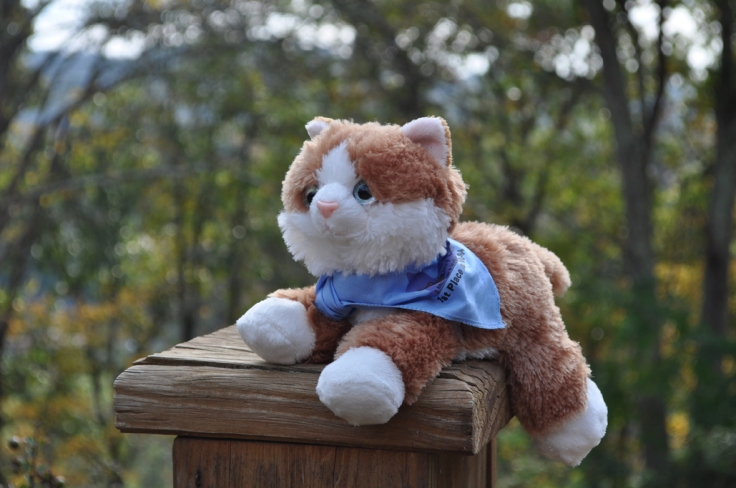
cat-1st-place

The other day I wrote a piece about coincidence (and how to resolve the unbelievable coincidences that hinder good story telling).

A couple of days later I tossed up a kind of random post about running hills.  I was just feeling good about still being able to challenge myself as I hobble into old man territory.  I directed the post to my New York friend, Cat Bradley, who is also a runner.  Little did I know that Cat was also doing hill repeats, and that even as I posted the photo of the hill I had just run, Cat was writing a post about her experience in forcing herself to run the hills.

Simply a coincidence of two people with similar interests having a similar experience at the same time?

Yeah, probably.

But while Cat’s story is ostensibly about running, you’ll see that it’s much more than that. It’s about what it takes to move forward in life. Click here.


Footnote:  The kitty in the photo is actually the First Place Prize I won in the Old Man Division of the Itty Bitty Kitty Committee 2 Miler a couple of years ago.  As you can imagine, the competition in the Old Man Division was very light that day.  Still, it took everything I had to get past the guy with the walker.

I wanna be a cowboy.

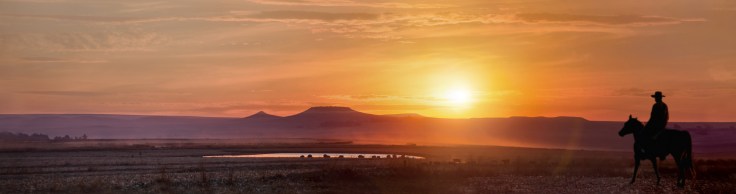
Sunset panorama in Durban

Are you a surfer or a cowboy?

What?

Are you a surfer or a cowboy?

Uh…cowboy?

Loaded question. Especially for me as a fifth grader from West Virginia, living in Houston, Texas. The wrong answer gets you in trouble. Gets you beat up.

Not really. At least not in the fifth grade. It was more of a starting point for a friendly argument. But what the heck did I know about being a cowboy or a surfer?

Cowboys are tough guys. Wear hats and boots. Eat beans by the campfire. Drink coffee in a tin cup. Ride the range on a horse.

Surfers are hip. Catch the wave and hang ten. Get all the cool girls. Tool around the beach in a dune buggy.

But in the fifth grade, I’d never ridden a surfboard.  Still haven’t. I had a cowboy hat and boots.  So yeah, I was a cowboy.

Tribalism. Even back then.

But there’s something about the cowboy lifestyle that’s still appealing to me. It’s simple.  Not a lot of flash. Lots of time for thinking things out as you do your job.  It’s the kind of life suited for someone who doesn’t mind being alone now and then. And the hats. Yeah, pull the brim down when you ride into town. And for the cowboy, love is strong and forever.

The fire had burned to coals and he lay looking up at the stars in their places and the hot belt of matter that ran the chord of the dark vault overhead and he put his hands on the ground at either side of him and pressed them against the earth and in that coldly burning canopy of black he slowly turned dead center to the world, all of it taut and trembling and moving enormous and alive under his hands.

What’s her name? said Rawlins in the darkness.

Alejandra. Her name is Alejandra.

— Cormac McCarthy, from All the Pretty Horses

photo credit: iStock Photography

Writing Tip – Coincidence?

Is there such a thing as coincidence?

Of course.  Or not.  It all depends on your philosophical or religious leanings.

The truth is, they happen all the time.  Explain them as you wish.

Example:

Heather is on her way to Houston to see her father.  She happens to stop at Galveston on her way.  She happens to take a walk on a fishing pier.  She happens to meet the very guy who was working at the pier when her mother was killed there ten years earlier.

Wow.  That’s a big coincidence.  Almost unbelievable.

But what if you knew early in the story that Heather knew that her mother was killed on a fishing pier in Galveston.  And that there are only two fishing piers in all of Galveston.  And that she stopped in Galveston for the very purpose of finding that pier. It goes from coincidence to purposeful event.  What about the guy at the pier?  Well, Heather knew his name because he provided eye-witness testimony ten years earlier.  He didn’t just work at the pier, he owned the tackle shop that operated on the pier.  An internet search told her he was still alive living in Galveston.  The odds of him working at the pier on the day she shows up?  Yeah, that takes a little fortuitous timing.  But stranger things happen all the time.

The key is foreshadowing and structuring the story in a way that dumb luck is taken out of the equation.  Be careful with coincidence.  Your credibility is on the line.


Writing Tip: Talk it Out

writing

I’m fortunate to belong to the Shelton College Review, a small group of writers who gather once a week to offer critique and encouragement – both are enormously important for writers – on our works in progress.

In reviewing one of my recent submittals, Larry was saying that he had been so caught up in the narrative, that he forgot that he was critiquing and was simply enjoying the story.  Until, that is, I threw in heaping helping of backstory.  His engagement came to a screeching halt.

I know better than to do that.  It’s one thing to sprinkle in a paragraph or two of backstory, but I took the reader out of a dramatic moment – in the back of an ambulance! – to tell about Heather’s life in high school.  Duh.

Thanks, Larry, for pointing that out. And as painful as that was to hear (that I could be so dumb), it was even harder to fix.  I’ve spent several hours setting things right, hours that I could have been using to write something new.

How did I fix it?

First, I spread it around a little.  Backstory in small doses (a couple of sentences) is acceptable.

Then I let the dramatic scene in the ambulance play out.  After things had calmed down, I worked some of the backstory into dialogue.  Things are still happening.  There’s still tension. There’s still character development as Heather and Lucas talk.  And the reader learns a little bit more about Heather and why she is the way she is.

And then there’s the little problem about coincidences.  More on that later.


Blog at WordPress.com.

Up ↑