Yet again I’m at my desk, working, with music in the background. Again it’s Wilco. I’m learning a couple of their songs and I’m letting them sink in. I came across this live performance of Shot in the Arm. When I play it on my guitar it’s just me and it’s a simple song, though the song itself is infused with conflict and doubt. In this live version, you see Jeff Tweedy up front, singing and playing his simple chords. In the background a whole heckuva a lot is going on. The conflict can’t be avoided. Doubt is everywhere. It’s all in the music and it might be a chaotic mess if not for the simple story (Tweedy) holding it all together. It makes a simple song complex and engaging. Good art and good literature do the same thing.
In The Darling, Chekhov tells the story of a woman who is somewhat of a serial lover, losing herself to whomever she loves. When we first meet Olenko, we admire her utter devotion to the man she loves. When he dies, she repeats the pattern with her new love. And when he dies, she repeats it again with her new love, and we begin to have questions about her. We begin to see the flaws in her character. And yet, her biggest sin is loving too much and too easily.
In his book, A Swim in a Pond in the Rain, George Saunders offers this about Olenka:
“I feel about Olenko the way I think God might. I know so much about her. Nothing has been hidden from me. It’s rare, in the real world, that I get to know someone so completely. I’ve known her in so many modes: a happy young newlywed and a lonely old lady; a rosy beloved darling and an overlooked, neglected piece of furniture, nearly a local joke; a nurturing wife and an overbearing false mother.
And look at that: the more I know about her, the less inclined I feel to pass a too-harsh or premature judgment. Some essential mercy in me has been switched on. What God has going for Him that we don’t is infinite information. Maybe that’s why He’s able to, supposedly, love us so much.”
A publisher has expressed interest in my novel, Heather Girl. They like the story and the primary characters; however, they feel that I have too many sub-plots and secondary characters that take away from the main focus of the novel. There are a couple of sub-plots and secondary characters that I have no trouble eliminating. There are others that I’m hesitant to lose.
I’ve been reading a book recommended by Mr. Larry Ellis, A Swim in the Pond in the Rain, by George Saunders. In the book, Saunders examines short stories of Russian authors so that writers may learn and hone their craft. Saunders just told me something that is helpful in evaluating Heather Girl. It is this:
Imagine we’re bouncers, roaming through Club Story, asking each part [of the story], “Excuse me, but why do you need to be in here?” In a perfect story, every part has a good answer. (“Well, uh, in my subtle way, I am routing energy to the heart of the story.”)
Our evolving, rather hard-ass model of a story says that every part of it should be there for a reason. The merely incidental (“this really happened” or “this was pretty cool” or “this got into the story and I couldn’t quite take it out again”) won’t cut it. Every part of the story should be able to withstand this level of scrutiny…
The second paragraph confirms what I think needs to be cut.
The first paragraph makes me hesitate on other parts, those that I believe are routing energy to the heart of the story.
“Some people are lucky. They become who they’re supposed to be,” he said. “This did not happen to me until I met your mother. One day we started to talk and it never stopped, this conversation.”
Martin speaking to Lianne on the occasion of her mother’s passing. From the novel Falling Man by Don DeLillo.
If you’re an author trying to get published, rejection is part of the process. I have no problem with that. As part of my day job as an architect, we submit our qualifications for projects and are rejected 90% of the time. It’s not that we’re not qualified; most of the time it just means we’re not a good fit for that particular project. It’s the same with writing. And though I’m accustomed to rejection in general, I’d like to see a little more success with my writing.
Authors seeking to be published by a traditional publisher generally seek agent representation first. Thus, agents are the first to offer rejection. Here’s a typical rejection letter (email) from an agent.
Dear Mr. Bird:
Thank you for your recent submission. We enjoyed reviewing your work. Unfortunately, at this time, we do not feel we have a good place for you on our client list. We wish you all the best success in the future.
Just a form letter. No real feedback. Nothing to tell you if your writing is truly bad or if it’s just a wrong fit for that particular agent. And this judgement is based typically on no more than the first 50 pages of your novel, and more often, the first 10 pages. I can also imagine than an agent can make the assessment after the first few paragraphs.
Here’s another I recieved.
Dear Mr. Bird,
Thank you very much for your query below. I liked the premise of this story, but I am sorry to say that I did not connect with the writing in the way I had hoped. For this reason, and with regret, I cannot offer you representation. However, I wish you every success and hope you will find the perfect home for this material.
Hey! Positive feedback. This was for Heather Girl and apparently she liked the premise of my story! So that tells my I’m not completely off base with the overall story idea. This is good. Great, actually. Now the bad news.
I did not connect with the writing.
In other words, my writing sucks.
This is what authors tend to do. One minute you’re receiving the Pulitzer, the next your pages are not worth lining the bottom of a bird cage. We’re an insecure bunch. Reality is somewhere in the middle.
After a few days of self-loathing, I decided to try to figure out why the agent might not have connected with my writing. Working under the assumption that she started at the beginning, that’s where I start. And one of the first rules of novel writing is to have a good opening hook. So I spent a few days trying to craft a hook. That was more or less a useless excercise.
Did the agent really not connect with my writing because I didn’t have a clever hook? I doubt it. It’s more than that.
What did I do?
I scrapped the first three chapters altogether. I’ve moved one of my favorite scenes to the beginning of the book. I think it’s more engaging and my hope is that readers will be caught up in the story right from the beginning and be completely unconcerned about the words I use to tell the story. It’s the story, after all, stupid. That stupid is for me.
Yes, it’s taken a lot of work to rearrange the pieces and I’ve lost some of my favorite passages in those first three chapters, but wasn’t it William Faulkner who advised authors to “kill your darlings”?
I’m almost ready to begin another round of agent submittals. We’ll see if any of this has helped.
As announcements go in a fourth grade class, that’s a big one. When your teacher says something like that, you first realize that she has a life outside of the classroom and that there are other people in her life besides you. And getting married? That’s a lot for a nine year-old to process.
It was a little school, Lakewood Elementary in St. Albans, West Virginia. Miss Yount was the teacher. (For the sake of simplicity, I’ll refer to her as Miss Yount, though Yount was her married name.) As tradition of the day dictated, the students would normally get their teacher a Christmas present. but being the wise young woman she was, Miss Yount asked the kids to come up with something “creative” instead of a traditional Christmas gift.
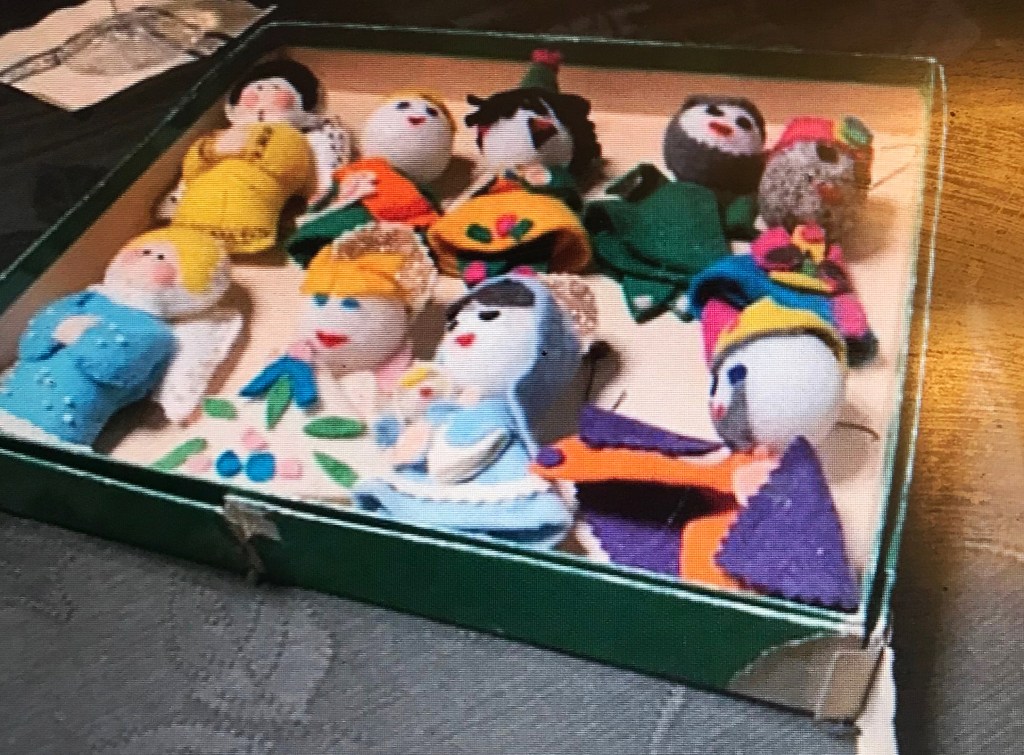
One of her students was Robert Taylor, the fourth child of seven in the Taylor clan. He was a serious student and took Miss Yount’s request to heart. Using a pattern his mother had, Robert fashioned a nativity scene using styrofoam balls and felt. Nine figures in all, including Mary and Joseph, angels, wise men, and shepherds. No phoning it in for young Robert Taylor. Even the face of the baby Jesus in Mary’s arms was detailed. An artistic masterpiece? No. But what is evident is the time and effort that he took to create this seasonal memento for a teacher he would not likely see again after he graduated fourth grade. There was obviously a fondness for her.
And so he graduated, and she married and moved away.
Robert grew up, graduated college and began working as a structural engineer for the U.S. Army Corps of Engineers, despite the B in math he earned in fourth grade from Miss Yount. He married, had four kids of his own and now has four grandchildren. He retired from the Corps a couple of years ago, but even after retirement, he has been to Mosul, Iraq five times where he has assisted in the engineering of the stabilization of the Mosul Dam. Miss Yount would be proud.
And then a couple of weeks ago, a message appeared on Facebook.
“I’m in search of a Robert Taylor, Asian-American who attended fourth grade at Lakewood Elementary School in St. Albans, WV. His teacher was Ms. Dale Yount. I believe the year would be 1967, 1968, or 1969. His expected age would be 60-62.”
It was a friend of Miss Yount, helping her try to find Robert Taylor.
After she left St. Albans with her husband, Mrs. Yount, now Dr. Yount, traveled the world. She lived in Egypt, Japan, Malaysia, England, Singapore and several states in the U.S. In all they had moved 39 times. At each place they lived, every Christmas Dr. Yount displayed the nativity scene that Robert had so carefully crafted so many years ago.
And she never quit thinking about that little boy and wondering how his life had turned out.
You can guess the rest. Yes, they have connected via email but have yet to talk to face to face. Her current residence is near the home of Robert’s youngest son so it’s likely a meeting will happen soon. It will be heartwarming in so many ways, and it seems they share the same values and the same faith. Which is one of the reasons the nativity scene that Robert made is so special to her. It’s not just another Christmas ornament, it depicts what Christmas is all about. It speaks of the eternal bonds of love and grace.
Merry Christmas.
copyright 2019, joseph e bird
This story is true, though some of the facts from 50 years ago are affected by fading memories. The author has taken the liberty to create a narrative that expresses the truth more or less as remembered by the participants.
Confidence. Most people only feel confident when they’re sure of themselves. The rest of the time, and generally the majority of the time, they’re faking it. It is impossible to tell the difference. Especially if you say less instead of more. Stand as straight as possible, and look people in the eyes during conversations.
Explaining. Don’t make explanations: Anyone who expects one has already come to his own conclusion anyway. Or, to quote a fortune cookie I got in Sacramento in 1992: Never explain. Your friends would never demand it, and your enemies will never believe you.
Be shrewd. Never go into business with a friend, or loan money if you expect it back.
Friendship. Very few friends last a lifetime. This is because people always change. This is the natural progression of life. When the shared experience is removed (school, work, community, club) there becomes no link or mutual appreciation. Expecting the friendship to retain the old mold will end in heartbreak. Move on and expect nothing. Appreciate the honor of glimpsing another human being’s life for a time – but keep growing.
Giving. A gift is not a gift without both hands open. If you expect something in return for a gift or favor, don’t give it. Give only for the good feeling of being able to share something. Anything else is usury.
Love. People are becoming afraid these days to make commitments and allow themselves to love others because they know the other person will either leave them or die. This is true. All the more reason to love them now. Change is the only thing we can depend on.
Reputation. Your name is the one thing no one can take away from you. It will be your most valuable resource. Make sure that when people hear your name they associate it with honesty and decency. This is more important than I can say here. Your word must be your bond.
Promptness. Always be on time, if not early, for any appointment little or small. Keep no one waiting. It is rude and presumptuous. It implies that your time is more important than theirs. Which is not so. All time is equal.
Courtesy. Look people in the eyes when you talk to them. Smile and mean it. Make it a point to remember the name of everyone you meet. Everyone likes to be known and remembered.
Tact. Life is full of petty irritations – people who say and do rude things, forget your name, seem to exclude you in or from gatherings, or generally fail to remember your own humanity. Let it go. Things are not always what they seem. People often have problems going on in their private lives that we know nothing of but would explain their apparent self-involvement. Try not to judge. Let it go.
Diligence. Bosses never want to hear why something didn’t get done. They are only interested in what has been accomplished or how soon it will be.
Responsibility. There is no one to credit for your successes or failures but yourself.
Clarity. Fear exists to show us where we need to improve ourselves.
Foresight. You can follow your heart if you want to, but be sure to pack a survival kit. Millions have already perished believing they could live on passion alone. It does not hurt to be practical.
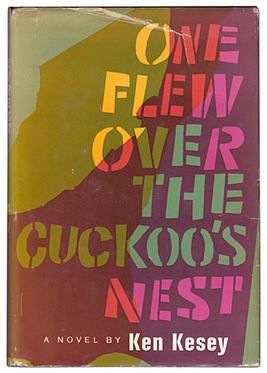
Want to know how to write a novel? Read One Flew Over the Cuckoo’s Nest, by Ken Kesey.
I saw the movie…40 years ago? I just read the book.
There’s so much to talk about. It’s a great book (but not without controversy) and another day we’ll get into what the book’s about.
If you’re a student of the craft of novel writing, you know the rules. And as you try hard to stick the rules, you see so many successful novels that break them. Cuckoo’s Next follows the rules. And is brilliant for it.
Plot Summary:
Randle McMurphy is serving a sentence at a prison work farm and gets himself committed to a mental hospital in hopes of doing his time in a cushier setting.
The Beginning:
McMurphy arrives at the hospital. No backstory. No set-up. No character development. No prologue, just story. In medias res. The way it’s supposed to be.
Point-of View:
The rules say to tell the story from one perspective. Yes, modern sensibilities allow for multiple points-of-view, but that approach is fraught with potential trouble. One point-of-view is the safe choice.
Cuckoo’s Nest is told from the point-of-view of mental patient, Chief Bromden, a Native-American. Everything is told from his perspective. If Chief doesn’t see it, we don’t see it. Chief can only surmise character motivations based on what he sees and what others may tell him. The author doesn’t jump around and tell us what the other characters are thinking. It’s all from Chief’s point of view. No omniscient narrator. And because we know what he thinks, we know much more about him than any other character.
The Protagonist:
McMurphy is the protagonist. That doesn’t mean he is the most virtuous character in the book. That’s probably Chief Bromden. McMurphy is the classic anti-hero. He’s not a good guy, but he’s very likable. And as he hustles his fellow patients, he does it in a way that lifts their spirits. Everybody loves him. Everybody but Nurse Ratched.
The Antagonist:
Sometimes the antagonist in a novel isn’t a person, but something keeping the protagonist from reaching his/her goal. McMurphy fighting the system? Well, yes, but the antagonist in Cuckoo’s Nest is not so amorphous. It’s Nurse Ratched. No doubt about it. One of the most unlikable characters I’ve ever met. She’s not evil in a Bond villain kind of way; she’s just cold and mean and against McMurphy in every way. The lines are drawn. The reader wants McMurphy to win. And Ratched to lose.
The Ending:
I’ve read that in classic literature, there is comedy and tragedy. The comedy isn’t necessarily funny; it’s prime characteristic is the happy ending. The tragedy is just the opposite.
Cuckoo’s Nest is a tragedy. The happy ending may give you a moment of contentment, but the tragedy stays with you, haunts you, makes you think. What might have been? What if McMurphy had won? What if Nurse Ratched had lost? Could it have made a difference for Billy Bibbit? And what of Chief Bromden? Did he ever make it home?
If you read this 50 year-old novel, you’ll be jarred by some references that are considered offensive today. But is it Kesey or his characters making the references? The characters, of course. They’re flawed. But does that give Kesey license to let them say what they do? We’ll get into that in more detail later. What Kesey does that’s indisputable is craft a story that takes you to the edge of realism at a pace that seems perfect. In the second half of the book, when the story rolls like a boulder down a mountain, he does nothing to get in the way. It’s a great example of plot and character development in perfect sync.
We’re visiting my brother-in-law, Paul, at the nursing home on top of the mountain in Williamson. It’s a typical visit. We bring Coca-Colas and 7-Ups. Not Pepsi. Not Sprite. Coca-Colas and 7-Ups. We drop them off at the dining hall where a local gospel group is beginning to play. Two men, two women. An acoustic guitar wired to a little Fender amp. They sing loudly, all feeling, no nuance. Gathered around are the usual assortment of residents in wheelchairs.
Paul is there but he has no interest in staying so we go back to his room to visit a little. After a while, it’s time to leave. We hear the music from the dining hall so we go back to listen for a bit.
The music is as country gospel as you can get, full of twang and southern West Virginia. They’re singing a song I’ve never heard.
Of course not like the video I just linked, but it’s the same song.
And there’s a lady lying horizontal in a wheelchair, clutching her sippy cup, her eyes closed. And she’s singing along.
In the back is another lady mouthing the words.
Gertrude, who says she’s ready to be with the Lord, is singing too.
John Michael looks to be in his thirties. He wheels up and asks for a microphone and one of the ladies obliges. John Michael sings his heart out, even if his voice is not what he wants it to be.
It’s hard not to be touched.
We finally leave and make our usual stop at Mickey D’s for coffee for the long ride home. Over the sound system, the Talking Heads song, Once in a Lifetime, is playing.
I remember the quirky alternative-rock song from so many years ago and it gets stuck in my head. I can’t remember all the words and when I get home I find it and play it.
you may ask yourself, well, how did i get here?
David Byrne’s philosophical musings about how life blazes by and here we are. How did we get here?
Most folks in the nursing home are probably not prone to introspection, but there a few. I’ve talked with a veteran with no legs and he may ask himself.
Larry has family issues that haunt him. He may ask himself.
Our friend Peggy would. My God, what have I done? Not a question she would ask in vain, but a sincere pleading.
 Joseph E Bird