Search

Joseph E Bird

Let's talk about reading, writing and the arts.

Tag

writing

Music of my day.

guitar 2-6-16 for web

Listening to the music of the Wonder to escape
Digging words and stories cause he always tell it straight
Life be scarred and dogs bite hard, to that I can relate
Soulful grooves, the spirit moves, tells me it ain’t too late

Driving horns lay down the tune, I’m hearing now the Tears
David Clayton Thomas sings, it’s not the dying that he fears
Spin the wheel, cut the deal, find wisdom in the years
Blues sung hard, and hope stands guard, a triumph for the ears

Singing with a nasal twang and tangled up in blue
The poet tells his story ‘bout the people that he knew
Stars are crossed and loves are lost, his heart we see straight through
A simple song to sing along, to change our point of view

A banjo picks the intro with a groovin’ upright bass
A nice and easy song of love, till the breakdown sets the pace
Toes are tapping, hands are clapping, the cello plays like grace
They sing of love and God above, our worries are erased

I play the C, I play the G, play the A chord in the minor
I write the words, scratch out a tune, plan it out like a designer
Find the truth, a touch of youth, up the beat to make it finer
But truth is cold, cause it ain’t gold, I know I ain’t no rhymer

Thank God for voice and stories told and those who came to play
The soft piano soothes the soul and carries us away
They give the beat and words complete, to speak what we can’t say
Turn it up and fill my cup, play the music of my day.


Copyright 2017, Joseph E Bird

jazzing up a classic

Editor’s Note:  I’ve been on a jazz kick lately and I remembered this post from a couple of years ago. In case you missed it the first time.


Dig it.

There’s a club in London called the Troubadour. It was founded in the 1950s and has hosted legendary musicians through the years. It’s also famous as a hangout for writers and artists and coffee-house poetry.

Finger snap.

Picture this: Stanley Kubrick had a favorite table at the Troubadour back in the early 60s. He comes in, sips espresso, takes in a poetry slam, and works on his screenplay for 2001: A Space Odyssey.

In 1968, his seminal film is released.

“Open the pod bay doors, HAL.”

“I’m sorry, Dave. I’m afraid I can’t do that.”

Far out.

Featured in the film was the music of Richard Strauss, specifically, Also Sprach Zarathustra, which, interestingly, is a tone poem. Look that up in your Funk and Wagnalls (Laugh-In reference).

In 1972, the jazz musician Deodato put out his take on the classic, which was later featured in the Peter Sellers film, Being There.

“As long as the roots are not severed, all is well. And all will be well in the garden.”

Heavy, man.

So for all you poets out there, put on your black turtleneck and beret, go back in time, and tap your toes to the groovy, jazzy, coffee-house version of Also Sprach Zarathustra by Deodato.

Dig it.


i hear the voice

i hear the voice
it’s yelling at me
i hear the voice
but i don’t agree
to argue is pointless
our words are in vain
i can’t understand
and you can’t explain
can we sit and be calm
and maybe break bread
i’ll listen again
perhaps i misread
and i hear the voice

i hear the voice
calling me to speak
i hear the voice
to say for the weak
is anger so righteous
that respect doesn’t matter
our cause is just
it’s yours we must shatter
walk with me now
let’s talk and be friends
to find the true answer
we must make amends
and i hear the voice

i hear the voice
telling me not to fear
i hear the voice
saying peace is still near
the strife of the world
is now and has been
and will be tomorrow
again and again
so let’s stand for the lost
and fight the good fight
but let’s do it together
for that is what’s right
and i hear the voice

i hear the voice
it’s soft like a dove
there’s no sound that i hear
does it come from above
i hear the voice
and you hear it too
let’s listen together
there is so much to do


copyright 2017, joseph e bird

Writer’s Log – Insomnia

Last night was one of those nights.  Fell awake around 3:00, finally decided to quit fighting it around 3:30.  I made a cup of tea and sat down in front of the computer. My imaginary friend, Heather, has been stuck in a waffle house for a few days now.  I’m sure she wishes I’d get her out of there.

So at 3:30, I was going to make something happen.

But.

4:00, and she was still there.  I had managed to go back and tweak a few things, made a couple of sentences better. But I was still blocked.

Maybe this is the end.  Maybe Heather never gets out of the waffle house. Maybe nobody cares what happens to her.

I’m 10,000 words in.  Not that much, really, in word count. I’ve abandoned novels at 40,000 words. Except that I’ve taken my time with these words, tried to write them better as I go. So it would be disheartening to pull the plug.

There’s a mother and a kid – a screaming kid – in the waffle house, too. At first, the mother was sitting with her back to Heather. I rearranged the furniture. Now they’re sitting beside Heather, facing each other, so that when Heather hears the kid scream and turns to look, she makes eye contact with the mother. It was an uncomfortable moment.

And then.  And then.  And then.

At 5:00, Heather was still in the waffle house. But things had changed dramatically. I was unstuck.  I went to bed.  I still couldn’t sleep, but it was a more restful insomnia.

Lesson 1: Maybe insomnia has a reason.

Lesson 2: Sometimes you just need to rearrange the furniture.

Lesson 3: Sometimes being uncomfortable is good.


Finding Ricky.

This won’t mean much to anyone except my family. My apologies.

Today I read that the Kennedy Space Center is going to start displaying the Apollo 1 capsule as a tribute to the three astronauts – Gus Grissom, Edward White, and Roger Chaffee –  who lost their lives in the launchpad fire fifty years ago. Around that time my family was living in Houston and my dad took me to the Johnson Space Center there to look at the rockets.

Today I went to Mapquest to see how long it would take to drive to the Kennedy Space Center.  13 hours, more or less. Then I checked Houston. 18 hours. While I was on Mapquest, I zeroed in on the old neighborhood. The apartments we lived in are long gone, but I recognized the streets. Japonica. Ilex. Redwood. Rustic Lane.

I thought about my Houston friends, and like I have done in the past, I searched the internet for clues of their whereabouts. Mostly I struck out. Then I found one. In an obituary in Louisiana.

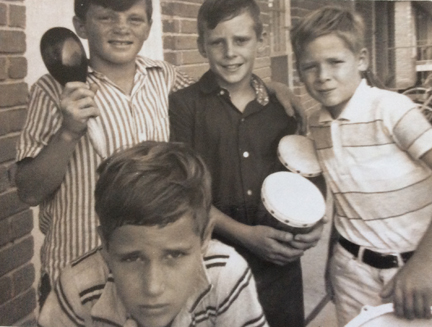
Ricky.

the-band-3-for-web

He’s the one with the maracas.

I wasn’t sure it was him until I watched a memorial video on the funeral home website. The pictures of him as a kid were unmistakable.  The obituary said he lived in Louisiana for almost fifty years. That left little time for living in Houston, probably the few years that my West Virginia family lived there. We were all transients, apparently.

So many of our friends disappear and we never hear from them again. We wonder whatever happened to them.

Looks like Ricky lived a good life and had a loving family. Which is exactly what I hoped I would find.


Writer’s Log – You think you know your characters?

I’ve been writing about Heather for a couple of months now.  You remember Heather, the woman with the two boys, living alone now that they’re out of the house. She studied Avery’s photographs in the coffee shop until she learned that her father was being let out of prison.  I thought I knew her, too.

But when she leaves for Texas to get her father settled in with her brother, she takes a detour to stop and see her ex-husband three states away.  I didn’t know she was going to do that until she started driving. And on the way there, she reveals a little something about herself that I didn’t know. Something a little disturbing.

How can I not know these things?  She’s an invention of my imagination.

There are fiction writing gurus who will tell you to plan your characters meticulously, to know their history, their families, their personalities, their moral standings, even which toothpaste they prefer. I can see the advantage to writing that way. There is less likelihood that your character will do something, well, out of character. These same gurus will also advise you to allow for the possibility that your character might surprise you along the way.

In my previous work, I’ve tried to outline my characters as much as possible. With Heather, as well as the other characters in my story, I’m completely winging it. It’s kind of like I’m along for the ride. What better way to get to know Heather than to spend three days in the car with her?  So, yeah, I was surprised at what I learned.

Then there’s her ex-husband.  I had some thoughts about what he might be like.  Some thoughts about why they weren’t together anymore.  But Heather hasn’t really told me anything about all of that yet, not even in the four hours it took to get to Charlotte.

It wasn’t until they were face to face that I started to see some things.

The front door opened when she was halfway up the sidewalk.

“I’ll be damned.”

He was wearing jeans and a white t-shirt and looked like he hadn’t shaved for a few days. His once-blonde hair was mostly dark brown now with just a little gray around the temples. It was long and unruly and made her smile. He was aging very well.

“Hi, Robert.”

“And out of sky she fell, like an autumn leaf floating on a cool October breeze, my beautiful Heather Girl.”

He was off the porch and had wrapped his arms around her before she made it to the steps.

“It’s so good to see you.”

His voice was almost a whisper, but not quite. A true whisper would have been out of place, maybe a little threatening, a normal voice would have lost the sincerity. It was the perfect intonation, the kind of thing that came natural to Robert Scott. She had no choice but to believe his words.

And so on.

Robert is as much of a surprise as Heather.  I’m glad I didn’t plan these guys out. I really think it would have stifled the creativity.  All of this may be a complete train wreck before it’s through, but I sure am having fun writing it.  Which for me, is the whole point.

Jazz Poetry

Every now and then I come across someone talking about the writing of Langston Hughes and I have been intrigued enough to add him to my list of authors to read. An African-American writer from the first half the 20th century, Wikipedia describes Hughes as a poet, social activist, novelist, playwright, and columnist, who occasionally found himself in the midst of controversy. The price of being a social activist, I guess.

So I was browsing through the local bookstore this afternoon and came across Selected Poems of Langston Hughes. I picked it up and turned to this poem, which I re-publish here at the risk of copyright infringement.

Bad Morning, by Langston Hughes

Here I sit
With my shoes mismated.
Lawdy-mercy!
I’s frustrated!

There’s more like that, light and unassuming. There’s writing about music, love and romance (love and romance, not necessarily the same thing), life’s annoyances and life’s tragedies, uplifting faith and disappointing lies.

But what makes it all so special is the way he tells it. Sure, there’s the outdated vernacular that might sound offensive to our enlightened(?) ears, but there’s an honesty to the writing, uncluttered with pretense, and a rhythm that is full of life, even in the midst of despair.

Still Here, by Langston Hughes

I’ve been scarred and battered.
My hopes the wind done scattered.
Snow has friz me, sun has baked me.
Looks like between ’em
They done tried to make me
Stop laughin’, stop lovin’, stop livin’ –
But I don’t care!
I’m still here!

At the time they called it jazz poetry.  I can dig it.

Words for a winter’s evening.

Good work from The Shelton College Review.

First, Larry Ellis has this piece that I can hear Garrison Keillor reading on the Writer’s Almanac:

Blackbirds in Winter

Andy Spradling has this philosophical offering:

Body and Soul

Good work, gentlemen.

Joe Durango

I’ve never been big on New Year resolutions, but I think I’m going to try the George Costanza thing and do the opposite. So instead of ignoring the resolution tradition, I’m going all in, baby!

I’m going to change my writing style completely, and while I’m at it, I’m going to introduce a new character that will drive my writing from here on out. Joe Durango.

I realize that’s not so much a resolution as it is just a change, but heck, let’s not quibble. This is a big deal.

Now the name Joe Durango evokes kind of a rugged image. You don’t want to mess with Joe Durango. So with my character, I need to figure out what kind of story to write.  Here are some options.

Joe Durango.  A tough, gritty cop.  Misunderstood, with a lot of personal baggage. Solves cases his way. Women are drawn to him, but don’t understand him.

“You are one damaged cop, Joe Durango,” Damonica said. Then she walked away.  

Joe Durango, the lonely hero.

Or.

Joe Durango.  A drifter, just looking for a steady paycheck and a bunk. No one knows much about his past, but he has a way with horses. The other cowhands are afraid to ask him about the scar on his face. Women are drawn to him, but don’t understand him.

“So, Joe Durango, are you ever going to talk about what happened in Carson City?” Annabel asked. She waited.  “No. I didn’t think so.”

Joe Durango, alone on the range.

Or.

Joe Durango. Baseball prodigy, came out of nowhere. Throws a fastball like no one has seen before.  He plays one game in the majors, then walks away from it all. A living legend in baseball, but the rest of his life is a complete mystery.  Woman are drawn to  him, but don’t understand him.

“Take me with you, Joe Durango,” Willow said. “I just want to be with you, wherever that may be.”
“Where I’m going is no place for a lady,” he answered.

Joe Durango, man of mystery.

No, not really.


Blog at WordPress.com.

Up ↑