
Search

Joseph E Bird

Let's talk about reading, writing and the arts.

Tag

writing

the free spirit.

GCB-sailor edited

This hip chick is my mother.

The photo was taken around the time she began her career as a stay-at-home mom.

If my father was a left-brain analytical, my mother personified the right-brain free spirit.

My mother had artistic ambitions. She was good with sketches, and I think I remember her working with pastels. But she was raising a family and it was hard to stick with it.

She was also a musician. She played the clarinet in the high school band (or faked it, as she would say, a skill I managed to master when I was in the band), and she was an excellent piano player. But she was raising a family and it was hard to stick with it.

She loved to write and was a master of the funny story. She wanted to be the next Erma Bombeck (a popular humorist of her day) and probably had the skills to pull it off. But she was raising a family and it was hard to stick with it.

Did I mention poetry? No, not the soul-searching free verse that is popular today, but poems that actually rhymed. And again, many were humorous. But she was raising a family it was hard to stick with it.

She also sewed and made clothes for the family. I consider sewing an art form, but for my mother, it was a necessary skill, one that she was able to stick with, because she was raising a family.

Like most right-brain thinkers, my mother had dreams of making it big, but they never panned out. Even so, at every stage of her life she was able to find contentment in the work that she did. Yes, she found happiness in her art, her music, her writing, her poetry. But she knew what was really important. It wasn’t a sacrifice for her to let her dreams take a back seat, it was her act of love for her family. She wouldn’t have it any other way.

Times have changed. With more options available, many mothers are able to work outside the home, fulfill their obligations as a mother, and still find time to pursue other interests. Roles are changing, too. Stay-at-home dads are much more common and give women even more choices.

But my mother’s world was different. Still, one truth remains.

Our time is short and our work is ephemeral.

Know what really matters and make the most of it.
Sing to me a truth.

Someone once told me that he had broken up with his girlfriend and he was having a hard time getting over it. Except he said it like this:

Most of the time
I’m clear focused all around
Most of the time
I can keep both feet on the ground
I can follow the path
I can read the sign
Stay right with it when the road unwinds
I can handle whatever
I stumble upon
I don’t even notice she’s gone
Most of the time.

That’s from Bob Dylan.  His song, Most of the Time.

Larry Ellis had this to say about poets:

“A poet is a maker.  A poet is someone who attempts to convey meaning and emotion through the creative use of language.  A poet employs metaphor to spark the imagination and meter and rhyme to trigger the memory.  Would we have understood – would we have “gotten” – the meaning of the Vietnam war – as the songwriters wanted us to get it – without the music and rhythm and rhyme of, for example Have You Ever Seen The Rain?”

It’s part of an essay that he wrote making the case that the prophets of old interpreted and proclaimed the meaning of events, and did so in a poetic language that would drive home their message (or God’s message) and be remembered.  You can read the entire piece here.

Such a poet doesn’t look to the clouds to find inspiration in the ether.  The poet has something to say and is deliberate in the choosing and placement of words.

The poet says, much like Bob Dylan or John Fogerty or Jeremiah:

“Listen.  I have something you need to hear.”


The Green Box

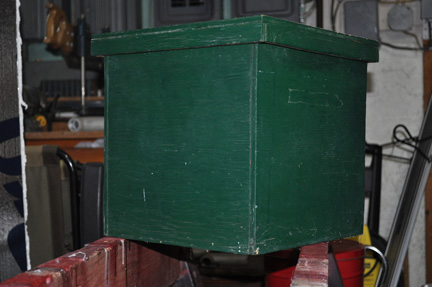
green box for web

I guess I was around fifteen. Maybe eighth grade. Back then that meant that I attended St. Albans Junior High, the old high school of my mother and father. Some of their teachers still taught there. Like Mr. Jordan, a science teacher, I think. Gordon T. Jordon, to be precise. In my mother’s time, they called him Gordon Tordon Jordon.

The old school is now a warehouse for old commercial kitchen equipment. Broken windows everywhere. Who knows what living inside. And a few ghosts from the past. Not literal ghosts, just haunting memories.

Like the first time I danced in front of people. Before I learned not to care what people thought. Bad memory.

Eating popcorn while watching a basketball game up on the mezzanine of the gym. Good memory.

Dodge ball. Crab ball. Climbing ropes. Does anybody really have a good memory of gym class?

We had a really good auditorium for its time. Like an old theater. Lots of good productions and student talent shows. Jack Lyons singing Mr. Bojangles. Good memory.

Almost getting beat up after school for mouthing off to an upper classman and being saved at the last minute by a teacher who saw the guy pull his fist back and yelled out the window just in time.

And then there was Shop Class. I was not a shop class kind of guy. In fact, I was still trying to figure out what kind of guy I was. I was dabbling in music, but was never really very good. Likewise with sports. Not super smart. Not super cool. Pretty much just another extra on the great movie set of life.

But Shop Class was required, so I spent a semester learning how to not cut off my fingers with a power saw, lessons I value to this day. Mr. Bass, one of the school’s coaches, also taught Shop Class. Scary guy. Big. Stern. Never smiled.

Steve Bailey was in my class. His family lived high on the hill in St. Albans. He was somewhat of a free spirit, but cut from a different cloth. His hair was long, all the way to his shoulders, which was not that unusual for the time, but he wore shirts with French cuffs and cuff links.  Nobody did that. So there he is in Shop Class with his fancy shirts. But he could be intimidating. Nobody made fun.

At the end of the semester, we had to put all of our newly learned skills to the test and actually make something. Anything. Other guys were making cool stuff. Maybe a gun rack. Or a table. I made a box. Roughly 12” x 12” with a lid. Painted green. A plain green box. Even at the time, I was embarrassed by my lack of creativity.

That was, what, 45 years ago? The box is still in my garage.

Today, I’m in the middle of a remodeling project in the basement. Over the years, the occasional water infiltration had caused mold to grow at the bottom of a built-in bookcase and the wood paneling behind it.  So I took out the bookcase. The rest of the paneling was still good and I didn’t want to rip out everything so I decided to cut off the bottom and rebuild with a new wainscot.

I drew a line on the paneling and five minutes later, the offending moldy panels were gone. A nice, clean cut.

It was satisfying. Even though it was really demolition, it felt creative. Like I was doing something positive. Something that few people would ever see. But it felt good.

I think that’s how it is with anything creative that we do. Whether anyone else appreciates it doesn’t really matter. We were born with that creative urge.

For some people, it’s masterpieces of woodworking or pottery or fantastic art or life-changing music or stories that take us to another world.

For some people, it’s children and families and making those around them feel loved and welcome.

For some people, it’s leading others to find greater truths.

And for some of us, it’s building a green box and cutting out the mold.

Simple creativity.

Not for the rewards. Not for the riches. Not for the accolades.

Just because we can.

A young woman dances.

A young woman dances.
She sees her future
and the possibilities
seem limitless.
Her joy is exuberant
and must be expressed.
So she dances.

A young woman dances.
I becomes we,
dreams are shared
and the path is changed.
Her joy is deep
and must be expressed.
So she dances.

A young woman dances.
Her life is not
as she thought
and there are limits.
Her joy is mature
and must be expressed.
So she dances.

A young woman dances.
She creates art
with pigments and
fabric and clay.
Her joy is in beauty
and must be expressed.
So she dances.

A young woman dances.
She is carefree and
moves with rhythm
and vitality.
Her joy is alive
and must be expressed.
So she dances.

A young woman dances.
The years have passed
but hope lies ahead
for all that is
good and pure.
Her joy is her faith
and must be expressed.
And so she dances.


copyright 2017, joseph e bird

He don’t have good sense.

It was an early evening.  The wife and I had been too busy for dinner at home, so we drove to KFC for something to go.

I don’t like the drive-through of any restaurant.  The lines are usually long and I get quicker service by going inside.  And with the drive-through, you don’t get to see the menu until you’re up to the speaker.

But it was past the dinner rush and there was no line at the drive-through so I pulled up to the speaker.  On the menu board, KFC was pushing their Georgia Gold Chicken. Now I’ve seen the ads on television with the latest incarnation of the Colonel covered in gold praising the new Georgia Gold Chicken, but I still didn’t know what it was.  It went something like this:

KFC Speaker Person (female): “Welcome to KFC.  Would you like to try our chicken pot pie?”

Me: “No thank you.”

At this point I pause.  I want to ask about the Georgia Gold Chicken but I’m not sure what I want to ask.  I see that there is no one ahead of me and I thought it might be easier to have a conversation about chicken face to face with the KFC representative.

Me: “Can I come up to the window to talk to you?”

Wife: “Joe!!!”

There is a long, long pause from the Speaker Person.  And then,

Speaker Person: “No, you can just order at the speaker.”

Wife: “I can’t believe you said that.”

Me:  “What?  I just want to talk about chicken.”

When I tell this story in person, it’s at this point that everyone’s eyes are wide in disbelief.  They can’t believe I said such a thing to the poor Speaker Person.  Everyone has had the same reaction.

So I order the Georgia Gold Chicken and pull up to the window.  The window slides open and the female Speaker Person, now the Window Person, tells me how much I owe her, and the Colonel, without making eye contact.

Me:  “I’m sorry. My wife says I shouldn’t have asked to come up and talk to you.  I just thought it would be easier that way.”

Window Person: “That’s ok. We never know what kind of people are in line.  We have to be careful.”

I apologized again, took our chicken, and went home.

Here is what I’ve learned: I don’t have good sense.

I still don’t see why asking to talk at the window is a big deal.  I obviously have poor judgment.  And that makes me question everything else I do in the public realm.  I may be committing other social transgressions without realizing it.

Such as complimenting someone’s tattoos.  When I do so, it’s because I really like your rose tattoo, not because I’m trying to put any moves on you.  I will refrain from complimenting tattoos in the future.

Or telling someone who passed me at the end of a race that they ran well.  That’s what friends and relatives are for.  Not creepy strangers.  I will refrain from offering encouragement to sweaty people.

Or commenting on a blog post of someone I don’t know. Yes, I know people put their posts out there so others will notice, but when my comments are ignored, I wonder if they think I’m a stalker. I’m not.  I’m just trying to be encouraging.  But I will refrain from commenting on blogs of people I don’t know.

There’s more, but you get the point.  He don’t have good sense.  Apologies to all.

And the chicken wasn’t all that good.


This is no good at all.

Ever say that about your work? Consider this:

Self-doubt can be an ally. This is because it serves as an indicator of aspiration. It reflects love, love of something we dream of doing, and desire, desire to do it. If you find yourself asking yourself (and your friends), “Am I really a writer? Am I really an artist?” chances are you are. The counterfeit innovator is wildly self-confident. The real one is scared to death.

Steven Pressfield

another song

this is exceptional songwriting.

Appalachian Spring

Larry Ellis posted this over at Home Economics. It’s a great description of where we live, in the heart of Appalachia.

At the end a character is introduced and then left standing there. The story of Jack Sampson is told in Larry’s award-winning novel, In the Forest of the Night.
_________________________________________________________

His ancestors settled in the central Appalachians without a thought for aesthetics. They came not for the beauty or value of this place, but only to escape from servitude and second-class citizenship in those cities to the north where their own forebears had landed as indentured servants. This new land to the south was steep, overgrown and not particularly amenable to the plow, but it was away from those engines of commerce and social institutions that had benefitted those to whom they were beholden and had just as certainly kept them a class away from full participation in the new nation’s economy.

The weather here was no more inviting than the soil. The winters were long and damp and made of days and weeks of snow so deep that travel was nearly impossible and in the summers the heat and humidity and insects were relentless. No one who had the luxury of considering the comforts a location might afford would have chosen to live here. There were no beautiful waterfronts and no rolling, thousand-acre spreads of black soil. All of life was closed in to narrow valleys and closed off to the flow of goods and information common to the new cities on the coast.

Those who came to escape the cities paid no heed to the hardships the land and the weather imposed, but lived their short lives together on subsistence farms, learning how to hunt and what to gather in the vast forests that surrounded their villages.

The generations brought change, of course. When those in the north learned that this land was rich in coal, oil and gas, industry came to Appalachia and the tiny villages became small towns and small cities and some made enough money to move themselves back into the mainstreams of commerce and society in the cities of the eastern plain..

It was, and is, an unromantic place. There are no ancient gardens or master artworks on display. There are no homes of famous artists or statesmen and no classic myth to fill the air with mystery.

But in the spring, something happens that no one who settled here saw coming and no one who has not lived here knows of or could even imagine. There are days in April when the scent of the blossoms all over the forests – the tulip poplar flowers, the lilac buds, the honeysuckle, the white blooms of the apple and plum trees, the new buds of the sycamore and the birch – all are lifted from the mountainsides in the softest breezes and the new warmth of the spring sun dries the stones on the edges of the creeks and branches and sends into the air cleansing mineral aromas and the trees on every hillside unfold in new green and soft rains fall and the forest floor thaws and releases the essence of the earth into the air. There are a thousand varieties of tiny plants that sprout under the canopy of the forest in these days. Only the Shawnee knew them. Only the Shawnee had given them names. They are tender and live only for days and in those days they release their own perfume, each a different, subtle taste. The clouds part and the grey of winter disappears and the sky is clear and high above the hawks soar and wheel on the gentle, warm thermals. The sun glistens on the rivers and those rivers run for those few days green and blue like the purest emeralds and sapphires. It is a season all its own, hidden from those who give names to such things, and in those few days the romance of this rugged place is enough to fill the longings of men’s souls and to ignite in their hearts even deeper longings.

It was in this time, in the middle of these days, that Jack Sampson fell in love.


Copyright 2017, Larry Ellis

morning conversation

mountains for webDo not go gentle
into
that good morning.

Isn’t that supposed
to be good night?

But it’s morning.

And why not
go gentle
into
that good morning?

The day is coming.
And it has teeth.
Lamb to the slaughter.
That kind of thing.

So.
Be the wolf,
not the lamb?

Just be ready.
Be on your toes.

I’m not a dancer.

It’s an expression.
But of course you know that.
You’re just being obstinate.

I’m listening to jazz.
I can’t be a wolf while
I’m listening to jazz.

See those gray clouds?
They’re a portend
of things to come.

But its warm.
And breezy.
I might just sit
outside
and watch the squirrels.

Don’t say
I didn’t
warn you.

Ok.

Listen.
Takuya Kuroda.
I’d rather go gentle
into
this
good morning.

Blog at WordPress.com.

Up ↑