If you’re a runner, and you want to shave a few minutes off your 5k time, slow down. I know this is counterintuitive, but if you want to run fast on race day, slow down on your training runs. Take it easy. And those long runs you’ve been putting in on Sunday mornings don’t do you any good either. Sleep in. Save your energy. Then on race day, you’ll be fresh and run faster than you ever have before.
Train smart, not hard.
No, not really. I’m lying.
If you want to run fast, you have to train fast. Not everyday, but you’re going to have to run fartleks or intervals or speedwork at the track. And yes, you still have to get up early on weekends and put in the extra miles. That’s the truth, kiddos. It’s hard work to run fast. It’s no walk in the park. More like torture in 90 degree heat, lungs about to burst. Or slogging through the rain or fighting the wind. Aching legs that keep you up at night. Is it worth it all just to run fast? That’s for you decide.
But if you want to be good at something, you have to train hard. There ain’t no shortcuts. And you have to want it pretty bad.
My grandfather, Justus Jennings Bird, died shortly after his 100th birthday.
His wife of 70-some years, Bettie Pearl, was 97 when she passed away.
I never knew my grandfather when he worked. By the time I was old enough to remember anything, he was retired and spent his time gardening. In the neighborhood, he was known as the man with the greenhouse. He would sell tomatoes and corn and green beans from his front yard in the shade of the tall oaks with the white-washed trunks. What he didn’t sell, Betty Pearl canned. They had home-grown vegetables all through the winter.
They had pride in their work. Pop’s rows in the garden had to be straight. Mom’s apple pie crust had to be perfect. It was good, healthy pride, not like the kind in the Bible that makes you bad, to borrow a phrase from an Avett Brothers song.
Of course there was no social media in their day. They would have enjoyed seeing photos of their family, but there would have been no pics of prize-winning tomatoes, no snap-shot of the perfect pumpkin pie. They were appreciative if someone liked what they did, but it wasn’t why they did it. Pop liked to grow things. Mom liked to cook.
Simple folk. Simple ways. A lifetime of contentment.
GIVE THANKS for the blessings of youth. It’s good to remember the old days, to think about those on whose shoulders we stand, who made us who we are today. To look back at all the grainy black and white photos.
But there is pure joy in youth and in witnessing the cycle of life.
The newborn crying one moment, and wide-eyed with wonder the next.
The toddler taking those first precarious steps.
Then there’s the challenge of adolescence. Maybe we’ll just skip over that. But all that angst makes us who we are.
And then the flower blossoms fully. It’s a sight to behold.
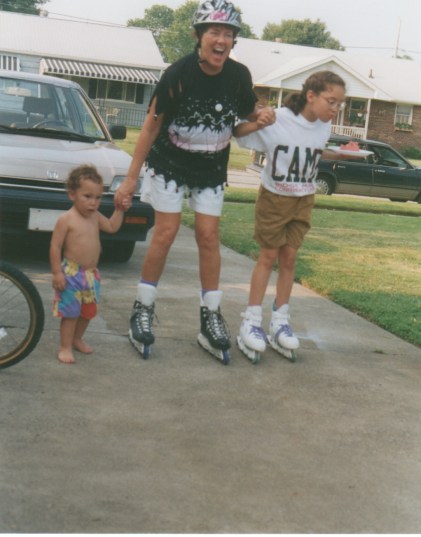
The photo is of Hannah, my niece. I could have chosen any of my nieces. Or nephews, for that matter. They all represent the best of life. But this is a great picture. Absolute contentment in the moment.
Here’s hoping we can all find that peace wherever we are and in whatever we do.
By the way, Hannah is the pre-teen deftly balancing a piece of cake while helping my mother on rollerblades. Photo credit (I think) goes to Hannah’s brother Micah, an award-winning filmmaker. Micah is the toddler in the crazy shorts also helping my mother.
My great-grandmother, Tida, with my sister, Adele.
When I was born, my great-grandmother, Tida, was 72. By the time I was old enough to form any memories about her, she was well into her 80s. I’m sure she had the usual trouble remembering things that older people have, but she had no problem performing at least one amazing feat of memory.
When she was a child in the late 1800s, she learned many things by simple repetition, what they used to call rote. When she was in her 90s, she would sit on her porch swing on a hot summer day and, recalling her lessons of decades earlier, entertain her great-grandchildren with the story of Nanny, a poor girl who ate too much. In today’s culture, we are more sensitive to eating disorders and those who struggle with controlling their weight. And really, the story of Nanny is more about greed than it is about being overweight. Nonetheless, my apologies to anyone who may be offended by this old school-house poem. My presentation of this is not intended to be any kind of commentary about eating or obesity. It’s about my great-grandmother’s amazing mind.
Again, she was in her 90s when she would recite this entire frightening poem by memory. Thanks to Adele for transcribing the poem.
Greedy Nan
Nanny was a glutton,
not a pretty word, oh well.
But the actions of a glutton
are even worse to tell.
Perhaps there are some children
who know the meaning not.
Well, a glutton is a person
who eats an awful lot.
Nan was fat and chubby
as folks should be who eat.
Her cheeks were like big apples
and she had fat hands and feet.
At the table Nanny always
ate up her own large share.
Then she would eat her brother’s
and hang around his chair.
If anything was left,
twas eaten up by Nan.
All her family said of her,
We don’t see how she can.
She’ll make herself quite sick some day,
her family all said.
She eats of every kind of food,
rather than wholesome bread.
One day some guests her mother had.
She cooked a supper good.
Then she set the table,
and placed on it the food.
But ere the guests should sit them down,
in ran greedy Nan.
She gathered all the nice food up,
and put it in a pan.
Then to the barn she ran away
and hid behind the gate.
She put the big pan in her lap,
and ate, and ate, and ate.
Her mother came and found her,
and sent her off to bed.
“I would not care if shadowbees
came after you,” she said.
As silent on the bed
lay greedy, greedy Nan.
She heard a voice say loudly,
“Get up now, if you can.”
She looked around,
her room was full of many shadowbees.
She wondered much what she could do,
their anger to appease.
“We’ll have to stop you. Hurry up!
This greed we cannot stand!
You are the greediest girl
there is in all the land.”
They put her in a towering room,
and filled it up with food.
“Stay here until you eat it all,”
cried they in language rude.
Now Nan was nothing loath to eat,
so straightway she began
to nibble doughnuts, cakes, and cheese,
and bread bespread with jam.
Till all at once the sight of food
made her so very ill.
“I never can eat all this up.
I never, never will.”
“Go on and eat!” cried shadowbees.
“You must eat more and more.
You haven’t made a passage yet,
but halfway to the door.”
“If I eat more, I’ll surely die.”
“Eat on!” cried shadowbees.
“While you’re eating your way out,
we’ll dance beside the sea.”
So Nan was forced to eat and eat.
She grew so very stout.
That when she reached the little door,
she hardly could get out.
“The time has come,” cried shadowbees.
“To roll her out like dough.
We cannot leave her as she is,
she’s much too fat, you know.”
So off they hurried luckless Nan
and down upon the plain.
They laid her like a heap of dough
to be rolled flat again.
They took a huge, huge rolling pin.
They rolled this way and that.
They rolled her up, the rolled her down,
til she was smooth and flat.
“We’ll round her off about the size
she really ought to be!”
The King said, “I’ll attend to that.
Please leave it all to me.”
So he rounded Nanny off, nice and trim and clean.
She jumped up with a scream,
and found that all this wretched tale,
was just a horrid dream.
“Oh, shadowbees, oh shadowbess,
I will, I wll give heed
to this dream that you have sent me,
I will stop this horrid greed!”
I love this photo for many reasons, but the thing that intrigues me the most is the honesty.
The photo itself is a basement shoebox relic. It’s old. It’s bent and cracked. No Photoshop effects, here. Just a snapshot.
The subjects are familiar faces, but the photo was taken probably close to sixty years ago, before I really knew them. Maybe before I was born. Even in the older women there is youth I never saw in later years. From left to right, my Aunt Shirley; my grandmother Bettie Pearl, who I knew as Mom; my great-grandmother Tida, who we called Tidy; and my mother, Gloria, who looks to be with child.
The place, I believe, is my great-grandmother’s kitchen. If I had to guess, I would say it was breakfast. There’s the coffee pot and toaster. But I can’t imagine them gathering so early just for breakfast. Maybe lunch, which they called dinner. Dinner would have included fried potatoes and tomatoes from the garden. Supper was the evening meal. There would have been men in the picture by then.
There’s tension evident in the photograph. Not a one could manage a smile, which is very unusual for my mother and Aunt Shirley, especially in front of a camera. There’s a weariness, too. Maybe they had been working. Maybe canning tomatoes or beans.
They were all different.
My mother was the free spirit, enjoying every moment.
My aunt was sophistication personified, full of grace and elegance.
My grandmother, hardworking and kind, ready to share with everyone.
My great-grandmother, the strong, independent woman living by herself.
Maybe that was the source of the tension. Around the table love and respect, yet each one not quite understanding the other. One dreams of this, another of that. And dreams, what are they for, anyway? another may think. And Tidy, who has already seen enough heartbreak for all of them, keeps it to herself.
I’ll never know. They’re all gone now. Not that any of them would give me a straight answer anyway.
I think that’ s the wonder of old photographs. They tell a story, but never the entire story. A moment frozen in time that forces us to think about those who have gone on, to see if we can fill in the blanks. It forces us to remember them as they were, beyond the smiles and laughter. It forces us to remember who they really were.
“Like the vast bulk of people, the captives would pass from the earth without hardly making any mark more lasting than plowing a furrow. You could bury them and knife their names onto an oak plank and stand it up in the dirt, and not one thing — not their acts of meanness or kindness or cowardice or courage, not their fears or hopes, not the features of their faces — would be remembered even as long as it would take the gouged characters in the plank to fade away. They walked therefore bent, as if bearing the burden of lives lived beyond recognition.” – Charles Frazier, from Cold Mountain
IN THE LATE 1860s, a tradition of decorating the graves of fallen Civil War soldiers began. In 1868, General John Logan formalized the tradition by declaring May 30 as Decoration Day. Decoration Day gradually become known as Memorial Day, and after World War I, Memorial Day began to commemorate soldiers who had died in any war. In 1968, the U.S. Congress passed the Uniform Monday Holiday Act, and in 1971, Memorial Day was established as the last Monday in May.
Although the emphasis of Memorial Day is still to honor those who died in service to their country, graves of all loved ones are now traditionally decorated on Memorial Day.
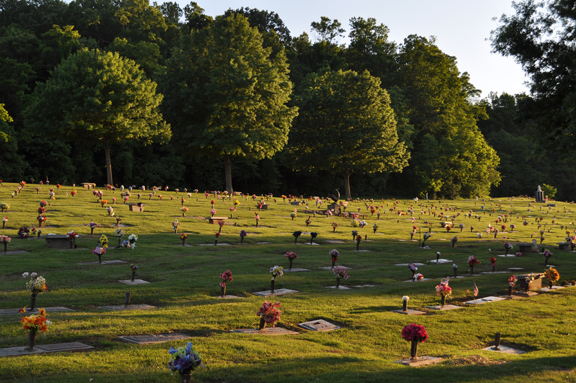
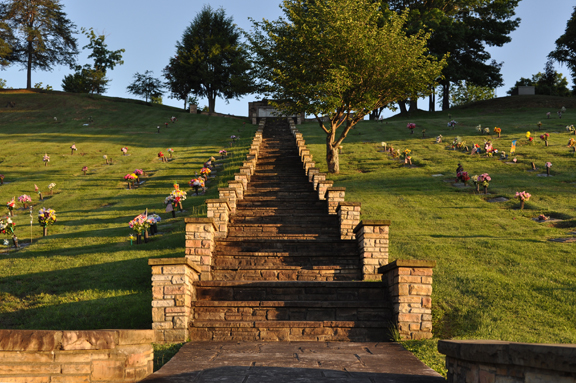
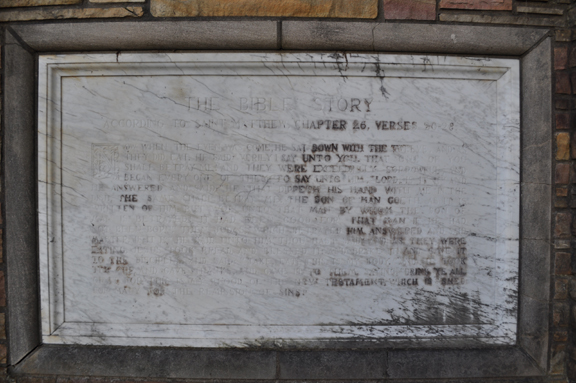
Many of my family and friends have their final resting place in Cunningham Park, a pastoral cemetery in the rolling hills of my home town of St. Albans. But as beautiful as it is, visits are always times of quiet reflection. My mother is there. My grandparents are there, and my great-grandmother, who passed away when I was 21, is there. My sisters and my cousins are the last generation to have known her personally. When we’re gone, my great-grandmother will likely have no more visitors. The memory of her, like the marble etching at the top of the cemetery stairs, once so vivid and clear, will fade away.
The stairs are a long, hard climb. Do they symbolize life’s struggles? Or the final path to the hereafter? At the top are symbols of the Christian faith. But time is no respecter. Even the marble fades.
Time for something really different. (Spoiler alert: The last link on this page is wild. You really need to watch it.)
The Mystery Hole in Ansted will have your head spinning. I’ve written about it before, but as long as we’re on the road, it’s worth stopping by. Up is down and sideways just doesn’t exist. It’s a crazy experience where the laws of gravity are completely violated.
Or head to Lesage for Hillbilly Hot Dogs, which was featured on Guy Fieri’s Diners, Drive-Ins, and Dives. Can a place so crazy really have good hot dogs? Yep.
Or maybe the Mothman Museum in Pt. Pleasant is your kind of place. And what would a Mothman Museum be without the M.I.B?
If all of this seems to tame for you, how about some whitewater rafting? The Gauley River in Fayette County offers truly world-class rapids. Check out the video for some live action. Go here to book a trip.
Hope you’ve enjoyed the tour of my world. We’ll do it again sometime.
I have a special needs brother-in-law who has lived in Logan, West Virginia for the past few years. More specifically, Whitman Junction, which runs along the holler formed by Whitman Creek. And yes it’s holler, not hollow. The houses of Whitman Junction – some ramshackle, some very nice brick ranchers – sit so closely together that you could sit in your kitchen and hear your neighbor’s cat purring next door, and so close to the road that a misjudged first step off the front porch could put you directly in the line of traffic. It’s what you would call a tight-knit community.
My brother-in-law has been in and out of Logan General Hospital recently, and is now recovering from a serious illness. Because of all of this, my wife and I have spent a great deal of time in the Logan area over the last few years. To know about Logan – and southern West Virginia – you need to know about the state in general.
Economically, West Virginia typically ranks near the bottom of the 50 states in just about every category. At one time, though, southern West Virginia was a booming coal mining region. But as mining has declined, so have the fortunes of southern West Virginia. Communities like Logan have been hard hit.
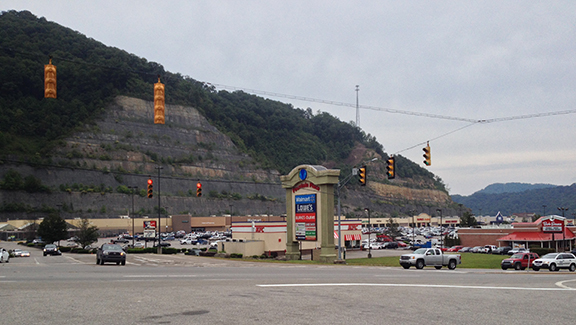
The geography and geology of southern West Virginia, specifically, the coal formed in the mountains eons ago, is what spurred the boom times of yesteryear. Those same mountains also tend to isolate southern West Virginia. The terrain is rugged. Check out this photo of the main highway leading to Logan. That’s a major cut through hard sandstone. And the next photo. It took a massive earthwork project just to build another Walmart.
The rugged terrain in Logan makes for expensive highways.
Even the shopping centers are carved out of the rock.
Add all this up and you get people who are different. I know I talk with an accent, but it ain’t nuthin like the accent of southern West Virginia. It’s also the land of camo. As in camouflage hats, camo vests, camo shirts, camo pants. You also see a lot of miners in their work clothes, easily identified by the bright orange reflectors. Yeah, the people are different. And they seem to have a little bit of a hard edge.
The other day we stopped to get a bite to eat and saw a couple coming out of the fast food restaurant holding hands. They were thin and wiry. He wore a scowl. So did she. Tough love, maybe? I’d be afraid of either one of them.
But maybe I shouldn’t be.
We had driven to Logan that morning, a Saturday, and were listening to This American Life. It was an old episode about a prison production of Hamlet. It was one of the most engaging shows I’ve ever heard on that broadcast. They interviewed convicted criminals who were trying their best to be actors. One of them acknowledged that his tough guy persona, the very thing that had landed him in prison, was an act. It was who he thought people expected him to be. It was, for him, a cloak of protection.
The people in Logan have had it rough. I’d probably scowl, too, if for no other reason, than to keep the world at bay.
And there are many, many good people in Logan. You can tell by the way the old guys wear their camo ball caps tipped back on their head. You can tell by the way the young girls in the stores go out of their way to make you feel like a long, lost cousin. You can tell by the 10-second conversation in the hospital elevator where a stranger tells you about the heartbreak she’s dealing with. Just like people all over the world.
If you lived in Hawaii, you’d probably smile a lot. Perfect weather, beautiful people, laid back attitude. If you lived in Logan, it would be tougher to smile. And yet they do. Even the scowling couple probably find contentment when their guard is down. They were holding hands, after all.
Wherever you go in your travels, you’ll find good people. It might take more of an effort to find them, but they’re there. Look past what’s on the outside, and find the goodness within.







 Joseph E Bird