Search

Joseph E Bird

Let's talk about reading, writing and the arts.

Tag

literary writing

Heather’s Father

A few days ago, my faithful friend and reader Lee Anne, commented that I hadn’t mentioned Heather lately, Heather being the main character of my novel in progress.

For those who may be new to the story, Heather has traveled to Houston, where her father, George, has been paroled. At this point in the story it has been revealed that her father murdered her mother. Heather hasn’t seen him or talked to him in the ten years since. Her sole reason for even going to Houston is to make sure her brother is prepared to take care of their father and that there is no chance that he will try to come to her home.

In this scene, Heather sees her father for the first time since his conviction. She and her brother are outside of an old school that has been converted into a community center. Inside, a group of parolees are finishing up a mandatory counseling session.


HEATHER HAD PAID NO ATTENTION to the empty classrooms as they had walked, but ahead, light shining through a long bank of windows spilled onto the sidewalk. As they approached, Wayne put out his arm and stopped her.

“They can’t really see because it’s dark outside.”

He took a couple steps forward. Heather followed. Inside, they sat in a semi-circle. A young man who look more like a boy, sat in front, notebook in hand. The counselor. She went down the line of old men. She couldn’t pick him out.

“Which one is he?”

“On the end on the right.”

“That’s not him. It can’t be.”

Wayne nodded. “That’s our dad.”

His shoulders slumped, his chin rested on his chest. His hair was totally white and stood from his head on weightless wisps. It was hard to tell as he sat on the metal chair, but he looked thinner. Not the stoic figure who had stood in front of the judge ten years ago and received his sentence. Not the man of confidence who had built his small engineering practice into a regional design firm. Not the imposing father she had looked up to when they worked together in the garage. This was an old man. A frail old man.

“I knew he would be older.” It wasn’t necessary to finish the thought and she let the sentence trail off. “He’s only seventy-three.” Then it occurred to her that maybe she had done the math wrong. Maybe skipped ten years. She looked at Wayne. “That’s right, isn’t it? Seventy-three?”

“Yeah. Chronologically. But biologically, it’s more like he’s ninety-three.”

She scanned the others in the class room. A few seemed more alert, but not by much.

“Is that what prison does?”

“I don’t know. All those guys, Dad included, are out because they’re either in their last months, or they aren’t who they were when they went it. Some don’t even know who they are.”

“You said Dad was sick. Is he terminal?”

“Not in the sense that you’re talking about. No cancer or congestive heart failure or anything like that.”

She thought about the alternative.

“Dementia?”

“Alzheimer’s.”

“How far along?”

Wayne shrugged. “You’ll see.”

The young man in the front closed his notebook and straightened in his chair. He looked at the old men, as if waiting for questions or comments. No sign of life from any of them. It seemed to Heather that as counseling sessions go, this had to be the least rewarding for the counselor. He forced a smile and then stood. Some of the men pushed themselves up and started shuffling toward the door. Most stayed seated, including their father.

Wayne and Heather walked around the building and by the time they got to the door, the lady who had smiled at Wayne earlier ignored him as she pushed her father out in his wheelchair. The young counselor was guiding their father by the elbow. He looked up at Wayne, then leaned in close to their father’s ear.

“I’ll see you next week, Mr. Roth.” He spoke more loudly than was necessary.

Their father reacted with a sharp turn of his head toward the counselor. “Geez oh wiz, why the hell are you yelling at me?”

It was the first time she had heard his voice in more than ten years and it was the one thing that hadn’t changed. A deep baritone. A little gravelly. Unmistakable George P. Roth.

She traded a look with Wayne. Both had been on the receiving end of his brusque reprimands many times, especially during their rebellious years. As he had aged, he had either mellowed by choice or contrition and he reserved his worst outbursts for politicians and TV preachers.

She wondered if Wayne had had the same flashback, but she dared not ask in front of him.

Wayne stepped forward and put one arm around his father’s shoulder and steadied him by the forearm. “Ready to go home?”

His father looked at his face, studied, then muttered something under his breath. Wayne gave Heather a quizzical look, Heather shrugged in return. As they stood side by side, she saw how much shorter he was than Wayne. He had always been taller. At least six-two. But now he was bent over and his legs never straightened.

They were still several feet from the door where Heather was standing, but everyone else had left. Even the counselor had gone back into the classroom. Her father glanced up to chart his course, but didn’t acknowledge her presence. He took a step.

It was then that she noticed her pounding heart. Her breaths became short and choppy. Though she had envisioned the conversation that she needed to have, the things she needed to say, she had given little thought to first words. In one imaginary scenario, he would see her for the first time, there would be a long pause, and he would begin with an apology. He would explain that he never meant to hurt her. That he understands why she hates him and understands if she never wanted anything to do with him again. Then she would tell him everything. How he had no right to do what he did. That he was selfish, thinking only of himself. That he robbed her of the chance to be with her mother when she needed her the most. No, she would say. I don’t want to see you again.

She took a deep breath, trying to regulate her breathing and slow her heart rate. It only made it worse.

He took another step. Then another. He saw her out of the corner of his eye. He glanced up, an annoyed look, as if he were irritated that she was in his way. She stepped back and held open the door. He shuffled through. He didn’t know her.


copyright 2017, joseph e bird

Check Engine

Joe H. used to say he didn’t have a creative bone in his body.  That was far from the truth. Consider this paragraph from an early draft of his unfinished novel, Test Drives.

“If Laura Lanham were equipped with a “check engine” light, perhaps someone she meets today would see something besides her silky dark hair, her high cheek bones, her cover-girl skin, and the way her jeans and her Alderson-Broaddus College sweatshirt seem to celebrate every swell and toss of Laura’s lithe body as it ripples beneath them. But that won’t happen today or any other day soon. For want of a simple warning light, Laura is allowed to roam the streets of Alban City in a large, gasoline-powered battering ram as if everything is fine, when it’s not.  In the year 2003 humans have not yet done for themselves what they have done for their cars, so the check engine light in Laura’s well-designed automobile will afford her car a level of protection Laura does not enjoy.” — copyright 2003, Joseph Higginbotham

Check Engine Light.  What a metaphor.

I look back on his writings and remember what I saw back then. A lot of understated but biting satire.  Characters that would be right at home in Twin Peaks.  I also see the autobiography in his characters.  Some in this one, some in that one.  Put it all together and you see everything that Joe wrestled with in his life.

No more.  He fought his good fight. He will be missed.


Can you handle the truth?

If you want to be better, you need someone who has the guts to tell you the truth.

Family won’t do that. Most friends won’t.  They want to encourage. They don’t want to hurt your feelings. They’ll lie to you and tell you work is wonderful, even if it’s not. But if you want to get better, you need someone who will tell you where you’re going wrong.

A few years ago I wrote my first novel, Counsel of the Ungodly.  It’s the story of Savannah Joyce, who fled big city life in Boston to set up shop in a small resort town in the mountains of West Virginia.  A new highway will bring more tourism to the area, but there will also be winners and losers as developers vie for prime real estate along the proposed highway. Savannah’s peaceful world is turned upside down and she realizes she can no longer run away from her past.

When I finished, I sent the book to Joe Higginbotham to take a look. Here are a few of his thoughts (along with my reaction to his comments).

JH: I have good news and bad news. The bad news is that Counsel of the Ungodly needs a lot of work. (Ouch.) The good news is that it’s worth it. (Ok, that’s better.)

JH: You’re opening paragraph needs a grabber. (Sure, I can work on that.)

JH: Your settings are weak. Each scene needs to answer the fundamental questions: what, when, where, who. (Seems like a lot of work, but ok.)

JH: Your dialogue is lazy. (Another ouch.) I think you’re trying to make your dialogue too realistic. Realistic dialogue is boring. Make every word of dialogue do one of two things: 1) Move the action, or 2) reveal character or relationship. (Ok, this is good. A lot of work to do, but good advice.)

JH: Your sentences, in places, are as meandering and indirect as the mountain streams of Hampshire County. (He was right. I still struggle with this.)

JH: I rejoiced when you finally killed Tim off. (Uh-oh. Tim was supposed to be a likable character.  The reader was supposed to be shocked and sad when Tim took the deep-six dive. JH had much more to say about why he didn’t like Tim.)

JH: I never liked Savannah. (Triple uh-oh. Savannah is the main character. She has to be likable. This is even worse than not liking Tim  JH had much more to say about why he didn’t like Savannah. My two main characters, and the reader doesn’t like them.)

You get the idea. Friends and family won’t tell you stuff like this so directly. JH had the guts to tell me not only what he didn’t like, but what he really didn’t like. Better Joe than a potential agent.

So I worked on the book and did the best I could with his suggestions. I entered the book in the West Virginia Writers Competition and it won first place. So yeah, I’m feeling pretty good about what I did. I sent Joe the revised copy.

JH: I calculate that this iteration of Savannah could not only beat 40 entrants from West Virginia, but another couple hundred form surrounding states. (Yes!)

JH: But you can and must do better. (I realize now that he was right. 100% correct.)

And then he followed that comment with three paragraphs of what I needed to work on with Tim, to whom he was finally warming, and Savannah, who in his mind, needed more clarification of her character and motivations.

Do you want to be a better writer? A better artist? A better song-writer? Find someone who knows what they’re talking about and ask them to be brutally honest. It’s the best way.

If you want to be a better writer, read these books.

I’ve always read a lot. Maybe not voraciously, I’m too slow for that. But I’ve read a wide range of books. When I began writing, Joe Higginbotham gave me books. Books that he bought for the sole purpose of sending to me so that I could experience good writing.

He was a big fan of Kurt Vonnegut so he sent me some of his books.  Slaughterhouse Five. Breakfast of Champions. Vonnegut is so different, so unique, it’s hard not to be influenced by his work.

He also introduced me to one of my favorite authors, Chris Offutt. Offutt is from eastern Kentucky, close to my neck of the woods, and his stories connect with me for that reason alone.  There is also a simplicity and directness in his writing.  The characters in his stories are not overly complex and their journeys are not epic, but they’re real people. Joe mailed me three of his books, The Good Brother, The Same River Twice, and No Heroes: A Memoir of Coming Home.  I’m glad he did.

He encouraged me to be a better business person and said I should read Fierce Conversations, by Susan Scott, Never Eat Alone, by Keith Ferrazzi, and Selling the Invisible, by Harry Beckwith.  I did. As well as many others that he recommended.

And the first book he said I should read – well, study really – was Louis Berkhof’s Systematic Theology.  Heavy stuff, man.

But that was Joe.  He knew what he was talking about and challenged you to be better. That’s a good friend.

This is how you write.

Joe Higginbotham was a great writer.  In 2010 he wrote a piece about his father, who had just passed away.  In doing so, he not only managed to tell us what was special about Emery Higginbotham, but he also took us inside the world of professional music and back in time to the British Invasion of the 1960s.  It’s timely, inasmuch as we are currently celebrating the 50th anniversary of the Beatles’ Sgt. Pepper’s Lonely Hearts Club Band.

If you want to know what good writing looks like, click the link below.

Emery Higginbotham

Joseph Higginbotham

From the Charleston Gazette-Mail is this:

Joseph Higginbotham, 62, of St. Albans, died Friday, June 2, 2017. If you are a family member or know the whereabouts of any family member of Mr. Higginbotham, please contact Bartlett-Chapman Funeral Home, St. Albans (304) 727-4325.

Joe was a friend for many years.

We had so much in common; we had very little in common.

At one time we shared a common faith.
And he taught me.
He taught me about theology.
About church history.
About caring for other people.
He was a great mentor, teacher, friend.

Things changed.
I don’t remember how or why.
We were all young and when you’re young,
life is constantly changing.
He moved away.

After many years, he became
whatever happened to?
I found him living in Lexington.
He had married.
He had divorced.
He had changed.

Our views of faith had diverged.
He no longer believed
as I believed.

Nonetheless, our friendship persevered.
I was writing a novel.
So was he.
And he taught me.
He taught me about story structure.
About voice.
About having something to say.

He moved back to St. Albans.
I was involved in community development.
He had been involved in Lexington.
And he taught me.
He taught me about the dynamics of community growth.
About seeing things from a different perspective.
About looking beneath the surface.

He was always doing that.
He had a great analytical mind.
He could provide so much insight.
He could be funny.
He could be maddening.
But he would always be your friend.

In his last years, we had diverged too far.
Conversations became more stilted.
So we just quit trying.
Maybe we shouldn’t have.
He deserves more than an obituary
that says nothing.

While we wait,
I’ll tell you about
Joseph Higginbotham.


Youth.

4565_587748181160_38912573_34018611_5539738_n

GIVE THANKS for the blessings of youth. It’s good to remember the old days, to think about those on whose shoulders we stand, who made us who we are today. To look back at all the grainy black and white photos.

But there is pure joy in youth and in witnessing the cycle of life.

The newborn crying one moment, and wide-eyed with wonder the next.

The toddler taking those first precarious steps.

Then there’s the challenge of adolescence. Maybe we’ll just skip over that. But all that angst makes us who we are.

And then the flower blossoms fully. It’s a sight to behold.

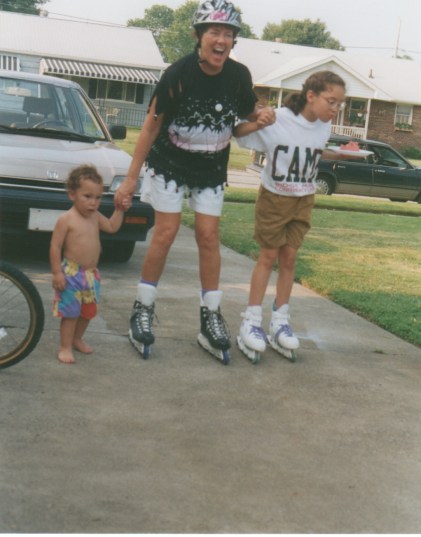
The photo is of Hannah, my niece.  I could have chosen any of my nieces. Or nephews, for that matter. They all represent the best of life. But this is a great picture. Absolute contentment in the moment.

Here’s hoping we can all find that peace wherever we are and in whatever we do.


By the way, Hannah is the pre-teen deftly balancing a piece of cake while helping my mother on rollerblades.  Photo credit (I think) goes to Hannah’s brother Micah, an award-winning filmmaker. Micah is the toddler in the crazy shorts also helping my mother.

Knock knock.

r and l 1 15
My mother’s first — and last — time on rollerblades.  

When was the last time you went roller skating?

When was the last time you ran?

When was the last time you rode a bike?

When was the last time you threw a ball?

When was the last time you swung on a swing?

When was the last time you danced?

When was the last time you told a knock-knock joke?

When was the last time you flirted with someone?

When was the last time you watched Bugs Bunny?

When was the last time you flew a kite?

When was the last time you did a somersault?

Pick one.

Do it.

While you can.

Body shaming in the 19th century.

tida
My great-grandmother, Tida, with my sister, Adele.

When I was born, my great-grandmother, Tida, was 72. By the time I was old enough to form any memories about her, she was well into her 80s. I’m sure she had the usual trouble remembering things that older people have, but she had no problem performing at least one amazing feat of memory.

When she was a child in the late 1800s, she learned many things by simple repetition, what they used to call rote. When she was in her 90s, she would sit on her porch swing on a hot summer day and, recalling her lessons of decades earlier, entertain her great-grandchildren with the story of Nanny, a poor girl who ate too much.  In today’s culture, we are more sensitive to eating disorders and those who struggle with controlling their weight. And really, the story of Nanny is more about greed than it is about being overweight.  Nonetheless, my apologies to anyone who may be offended by this old school-house poem.  My presentation of this is not intended to be any kind of commentary about eating or obesity.  It’s about my great-grandmother’s amazing mind.

Again, she was in her 90s when she would recite this entire frightening poem by memory.  Thanks to Adele for transcribing the poem.

Greedy Nan

Nanny was a glutton,
not a pretty word, oh well.
But the actions of a glutton
are even worse to tell.

Perhaps there are some children
who know the meaning not.
Well, a glutton is a person
who eats an awful lot.

Nan was fat and chubby
as folks should be who eat.
Her cheeks were like big apples
and she had fat hands and feet.

At the table Nanny always
ate up her own large share.
Then she would eat her brother’s
and hang around his chair.

If anything was left,
twas eaten up by Nan.
All her family said of her,
We don’t see how she can.

She’ll make herself quite sick some day,
her family all said.
She eats of every kind of food,
rather than wholesome bread.

One day some guests her mother had.
She cooked a supper good.
Then she set the table,
and placed on it the food.

But ere the guests should sit them down,
in ran greedy Nan.
She gathered all the nice food up,
and put it in a pan.

Then to the barn she ran away
and hid behind the gate.
She put the big pan in her lap,
and ate, and ate, and ate.

Her mother came and found her,
and sent her off to bed.
“I would not care if shadowbees
came after you,” she said.

As silent on the bed
lay greedy, greedy Nan.
She heard a voice say loudly,
“Get up now, if you can.”

She looked around,
her room was full of many shadowbees.
She wondered much what she could do,
their anger to appease.

“We’ll have to stop you. Hurry up!
This greed we cannot stand!
You are the greediest girl
there is in all the land.”

They put her in a towering room,
and filled it up with food.
“Stay here until you eat it all,”
cried they in language rude.

Now Nan was nothing loath to eat,
so straightway she began
to nibble doughnuts, cakes, and cheese,
and bread bespread with jam.

Till all at once the sight of food
made her so very ill.
“I never can eat all this up.
I never, never will.”

“Go on and eat!” cried shadowbees.
“You must eat more and more.
You haven’t made a passage yet,
but halfway to the door.”

“If I eat more, I’ll surely die.”
“Eat on!” cried shadowbees.
“While you’re eating your way out,
we’ll dance beside the sea.”

So Nan was forced to eat and eat.
She grew so very stout.
That when she reached the little door,
she hardly could get out.

“The time has come,” cried shadowbees.
“To roll her out like dough.
We cannot leave her as she is,
she’s much too fat, you know.”

So off they hurried luckless Nan
and down upon the plain.
They laid her like a heap of dough
to be rolled flat again.

They took a huge, huge rolling pin.
They rolled this way and that.
They rolled her up, the rolled her down,
til she was smooth and flat.

“We’ll round her off about the size
she really ought to be!”
The King said, “I’ll attend to that.
Please leave it all to me.”

So he rounded Nanny off, nice and trim and clean.
She jumped up with a scream,
and found that all this wretched tale,
was just a horrid dream.

“Oh, shadowbees, oh shadowbess,
I will, I wll give heed
to this dream that you have sent me,
I will stop this horrid greed!”

— Author Unknown

Blog at WordPress.com.

Up ↑