“Playwright Tom Stoppard once said the reason he writes is because every once in a while you put a few words together in the right order and you’re able to give the world a nudge. And sometimes I’m able to do that.”
— Charles Krauthammer
“Playwright Tom Stoppard once said the reason he writes is because every once in a while you put a few words together in the right order and you’re able to give the world a nudge. And sometimes I’m able to do that.”
— Charles Krauthammer
Her father stirred. He raised his head and looked around.
“Pip?”
Wayne and Heather looked at each other.
He father pushed himself up in the chair. “Pip?” His voice was stronger.
It took her back to the garage. Her tomboy, grease-monkey days. The good days. The best days.
It was a nickname Wayne had started and she had always hated. Pip. Pippi. As in Pippi Longstocking. Precocious kid from an old movie. Goofy, red pigtails and a gap-toothed smile that seemed frozen in perpetual amazement. She hated the reference. She hated the name. Which only made Wayne use it more.
Sometime after Wayne had begun his new quest to irritate his little sister, she was in the garage with her father. It was a hot summer evening. A fan blowing the greasy air around, making it just cool enough to be tolerable. A Reds game on the radio. He was working, she was watching. Just happy to be away from Wayne. She would go from bench to bench, running her hands over the cool steel of the tools, picking up a hammer or a pipe wrench or anything that looked too big and heavy to handle. She would hold it in both hands, amazed that anyone could make use of something so cumbersome.
The radio announcer droned on. The sleepy one. There were always two doing the game. One was more energetic and then there was the sleepy one. Talking so slow. So easy. She could sleep to the sound of his soothing voice.
Two and two the count.
She had no idea what that meant. Meaningless numbers. Just part of the peaceful background.
Check swing, fouled off.
“Did he just say Chuck Swain?”
“What’d you say?”
“The radio announcer. He just said something about Chuck Swain? Why would he be talking about Chuck Swain?” Chuck Swain being her friend who lived two blocks over.
Her father laughed.
“No, not Chuck Swain. Check swing. It’s when the batter almost swings but stops himself. Check swing.”
“Oh.”
Swing and a miss. That’s the third strikeout for Hernandez.
Her father laughed again. “Chuck Swain. That’s a good one.”
It made her feel good to make her father laugh.
“Hey, Pip, can you hand me those channel locks on the bench there?”
Pip. Not Pippi. Just Pip. And there was something in the way he said it that was not demeaning. Not a nickname to be cruel, a pet name. A name that would be special to her for the next several years.
She studied the assortment of wrenches on the bench. She saw one with the words Channel Lock imprinted on the silvery-gray steel.
“This one, Daddy?” It was heavier than she thought it would be and she almost dropped it on her foot.
He looked up from under the hood of the car. “Yeah. That’s it.”
He took the wrench and positioned it around a fitting. Somewhere down in the tangle of greasy parts and rubber hoses, she saw another wrench at the other end of the fitting.
“Here, hold this.” He motioned for her to take the handles of the channel locks. “Both hands. I’m going to turn the other wrench and I want you to try to keep the wrench from turning, ok? Just pull back and don’t let it turn.”
She nodded, completely sure that she wouldn’t be able to do what he had asked. And when he started on his end, the wrench in her hand lurched forward.
“Ok, pull back hard.”
She steeled herself and pulled back, putting as much of her ninety pounds as she could in the effort.
He grunted. She felt the pull on the wrench, but resisted. It moved a little and she pulled even harder. Then it broke loose. The wrench stayed wrapped around the fitting but she fell backwards and ended up on the floor.
“Got it.” Then he saw her sprawled out. “You ok?”
“Did you get it loose?”
“We got it loose. Good job, Pip.”
He helped her up and he went back to work. But everything had changed.
And now, in Wayne’s spartan living room in Texas, this old man spoke and she responded.
She walked over to the sofa and sat down as he followed her with his eyes.
“Hi, Daddy.”
copyright 2018, joseph e bird, from the novel Heather Girl
Just a closer walk with Thee.
Grant it, Jesus, is my plea.
Darnell downstairs, singing. The clang of the skillet on the stove. Breakfast on a Sunday morning.
Daily walking close to Thee
Let it be, dear Lord, let it be.
She closed her eyes, tried to find more sleep, but the sun was lighting the room and Darnell wouldn’t stop singing, though he just kept repeating the same refrain, and the banging pots were like an alarm set to repeat every two minutes. So she got up and put on her clothes from the day before and made her way downstairs to the kitchen.
I come to the garden alone.
At least he had changed songs.
Her father sat at the kitchen table, a cup of coffee in front of him. She went straight to the counter and poured herself a cup.
Darnell still hadn’t noticed her.
While the dew is still on the roses.
She went back to the table and pulled out a chair and sat with her father.
“You boys are up early.”
Darnell turned around.
“This is the day that the Lord hath made. I will be rejoice and be glad in it.”
“Sure.”
“Scrambled eggs?”
“Sure.”
He pulled three plates from the cabinet and dished out eggs on each one, then two strips of bacon, then toast.
“You’re going to make someone a happy wife someday, Darnell.”
He laughed and took his place at the table.
“Bow your head, Pops.”
And he did, as did Heather, but she didn’t close her eyes.
“Dear Lord, thank you for another day of life, another Lord’s day, and for this wonderful food you have provided. Be with our family, Lord, and bless us and draw us closer to you. Amen.”
She looked up. Her father’s head was still bowed. Maybe he was praying.
“Ok, Pops. You can eat now.”
He looked up, first at Darnell, then at Heather.
“Pip.”
“Good morning, Daddy.”
And they ate.
Her right arm felt funny. Under the table, her right leg twitched. She switched to her left hand.
“You prayed for your family. Back in Texas?”
Darnell was about to take a bite of his toast, but stopped and put it back on his plate.
“No, ma’am. I don’t have family in Texas. I mean I have relatives, but no family.” He held his hands out over the table. “This family. Us.” He picked up his toast and took a bite.
There’s different kinds of family.
So said the roughneck-turned-tackle shop owner.. The full-time philosopher and quiz show aficionado. Lucas.
Well, this one was different, for sure.
“What constitutes a family, Darnell?”
He took another bite of toast and studied on an answer.
“I don’t know if I can proper answer that. It’s not like I been studying on the situation and come to a conscious conclusion. It just feels like family. You’re like a sister. Maybe a little like a Mom. And Pops is Pops.” He shrugged. “Family.”
Part of her wanted to argue. This was no family, despite the fact that there was a biological link sitting right across the table, staring at his eggs, chewing on a strip of bacon, completely unaware of the conversation going on right in front of him. Her father? No. At best an empty shell. Worse, a selfish, uncaring man who took away her mother. Her father was just a dusty memory. And Darnell a brother? Just because he takes care of her father and helps around the house and runs errands for her and cooks breakfast, doesn’t mean he’s family. She could get the same service from a temp agency. And besides, it was all temporary. They’d both be going back to Texas before too long. House guests was more like it. And guests was being generous.
Still, the eggs were good, and the morning was peaceful. And if she were being truthful, it beat having a bowl of cold cereal by herself.
Darnell was humming Just a Closer Walk with Thee.
“Wish I could remember the words. All I know is the chorus.”
“Can’t help you there.”
She knew the hymn. At least it was familiar. Maybe from the times she went to church with her mother as a child. Maybe from the radio or television or a scene in a movie. The tune was easy and soothing and the kind of melody that would find a home in the mind and drift to the heart and grow into the soul and become a part of the collective memory that would come forth unexpectedly and bring with it a wash of sentimentality.
The smell of bacon would linger as the eggs disappeared and the coffee cooled. The last bite of toast with strawberry jam. The quiet clinking of silverware on the plates ceased and all was quiet. Soon the day would begin in earnest. Even if this were Darnell’s contrived family, it was nice.
Let it be, dear Lord, let it be.
“Thanks, Darnell.”
“You’re welcome. Me and Pops are going to church this morning. You should come with us.”
And there was the other aspect of her unknown father she hadn’t taken the time or made the effort to reconcile. He had never been a church-going man. He was, at first, her good father, always there for her, always including her and making her feel special. He just didn’t go to church. That was her mother’s thing. And their family had been just fine without church. Although looking back she wasn’t sure how true that was. Then he murdered her mother, went to prison, and found religion. It was a cliché that hardly warranted consideration. And it wasn’t like she could have a conversation about it even if she wanted to. His mind was gone, and with it, all memories, logic, reason, and explanations of anything that would make sense of his life, or his life with her mother, or his role as a father. If it was all incomprehensible to him, how could she ever understand?
copyright 2018, joseph e bird; from the novel Heather Girl
Is there such a thing as coincidence?
Of course. Or not. It all depends on your philosophical or religious leanings.
The truth is, they happen all the time. Explain them as you wish.
Example:
Heather is on her way to Houston to see her father. She happens to stop at Galveston on her way. She happens to take a walk on a fishing pier. She happens to meet the very guy who was working at the pier when her mother was killed there ten years earlier.
Wow. That’s a big coincidence. Almost unbelievable.
But what if you knew early in the story that Heather knew that her mother was killed on a fishing pier in Galveston. And that there are only two fishing piers in all of Galveston. And that she stopped in Galveston for the very purpose of finding that pier. It goes from coincidence to purposeful event. What about the guy at the pier? Well, Heather knew his name because he provided eye-witness testimony ten years earlier. He didn’t just work at the pier, he owned the tackle shop that operated on the pier. An internet search told her he was still alive living in Galveston. The odds of him working at the pier on the day she shows up? Yeah, that takes a little fortuitous timing. But stranger things happen all the time.
The key is foreshadowing and structuring the story in a way that dumb luck is taken out of the equation. Be careful with coincidence. Your credibility is on the line.
Long time writing friend, Elizabeth Gaucher, posted an essay by Loren Eaton, wherein he posits that writing is sometimes like “chipping a channel out of bedrock with a pen.” You can’t expect the initial passion of a project to propel you to 80,000 words. It takes hard work. A little every day. Especially if your writing involves something more than a Tweet or a Facebook post.
You don’t wake up on a Saturday morning and decide to run a marathon. You’ve got to put in the miles. Every day.
You don’t pick up a guitar for the first time and play Classical Gas. You’ve got to practice. Every day.
Don’t make excuses.
Write a sentence today. It will likely turn into a paragraph. And a page. And a chapter.
Keep chipping at the bedrock.

There were a few people on the beach, walking slowly, their heads down, scanning the sand for surprises from the deep that always appeared after a storm. A yellow umbrella pitched in the sand near the surf caught her eye and though she couldn’t see, she knew there was an old man underneath, his skin dark and leathery from his years in the sun, his shirt – a short-sleeved button-up, despite the cool weather – bleached a pale blue. There was a tackle box by his side and an always empty creel, though surely he would catch something sometime. Surely. He would sit in his beach chair and smile anyway, as if he knew he were part of the scene, part of what the people from the city expected to see when they came with their pale flesh, soon to be pink flesh, to walk on the hard, grainy sands and evaluate their lives and make big plans that would carry them back to their tedious jobs and their monotonous neighborhoods with a feeling of hope that would last a couple of weeks, maybe three, before comfortable complacency engulfed them once again and relieved them of any responsibility of living a more meaningful life. And it always happened on days like this one, not in the bright of a too hot day where the heat and lotions and kids crying in the distance worked to produce nothing better than a brief nap, followed by a short walk to the water to cool the feet, maybe venture in up to the knees, but never farther. No, the deep contemplation happened on the overcast days where the obligatory roasting in the sun was excused and those with no inclination for inner reflection went to the mall, while those who still had hope went on the long walk to the pier.
copyright 2018, joseph e bird, from the novel Heather Girl.
“I guess I misjudged how quickly the darkness falls.”
— Heather Roth, from the novel Heather Girl
copyright 2018, joseph e bird

Yesterday I drove from Lexington to Louisville along the Bluegrass Parkway. It was mile after mile of picturesque, bucolic, pastoral scenery, on what had to be the most beautiful day of the year. It is impossible to have gloomy thoughts while making this drive on a day like that.
Utterly impossible.
How can one ponder the human condition when the day is perfect?
How can a writer let his imagination wander to the struggles of mankind when the grass is so green?
Writers need the the grit of the dark alley.
Writers need the longing promise of the empty train platform.
Writers at least need some rain, or run-down barns, or the crusty old farm hand thinking about his past.
There’s another part of Kentucky – eastern Kentucky – that’s ripe for stories. But not this stretch of highway.
No way.
Photo Credit: Walt Roycraft. The photo is the property of GRW, my employer. The architects of GRW design, among other things, equine facilities. This is the site of one of our projects, the Adena Springs Horse Farm in Paris, Kentucky. Very much like the scenery I passed on my way to Louisville.
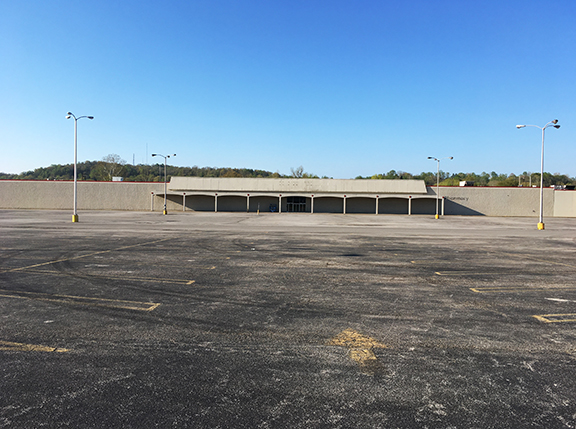
what’s that building?
it used to be a store.
a store?
people used to go there to buy things.
what kind of things?
clothes. paint. medicine. watches. televisions. tools.
why didn’t they just order it?
it was different then. people wanted to see what they were getting.
why?
i don’t know. something about feeling the heft of a hammer in your hands. seeing how a watch looked on your wrist. or shoes on your feet.
seems like a lot of trouble.
i guess. sometimes they’d sell hot dogs out front. or brownies.
why?
cheerleaders raising money for uniforms. veterans helping veterans.
what’s a veteran?
people who went to war defending our freedom.
war is bad, isn’t it?
yeah. it can get complicated.
why is there so much pavement in front?
people used to drive cars.
you mean ride in cars?
no. they actually drove cars. everybody had a car. they’d keep it at home and drive it to the store.
no way.
yes. and they’d leave their cars all over the pavement while they went in the store and shopped.
that’s just crazy.
maybe. but it worked. i met your grandmother in that store.
was she shopping?
no. she was a cashier.
what’s that?
we used to buy things with money. dollar bills. coins. we’d pay the cashier before we left with whatever we bought.
grandma was a cashier?
i went to the store a lot. bought things i really didn’t need just for the chance to talk to her.
why didn’t you use an app?
you can’t flirt with an app.
why do you need to flirt?
you don’t. it’s just part of the dance.
you danced, grandpa?
oh yeah. we danced, all right.
so what’s with the rocket?
beats me. we never did figure that out.

The first photo is the former K-Mart in my small town, closed just a few weeks ago. It’s unsettling how deserted the parking lot is now. To the right, just out of the frame, a Kroger store continues to thrive, so it’s not quite the apocalypse. Not yet. The sign in the second photo is soliciting tenants for the vacant building. In the background, across the highway on the riverbank, is the rocket of St. Albans. I’ve lived here all (most) of my life and have no idea why we have a rocket on the riverbank by the highway.
images and story copyright 2018, joseph e bird
 Joseph E Bird