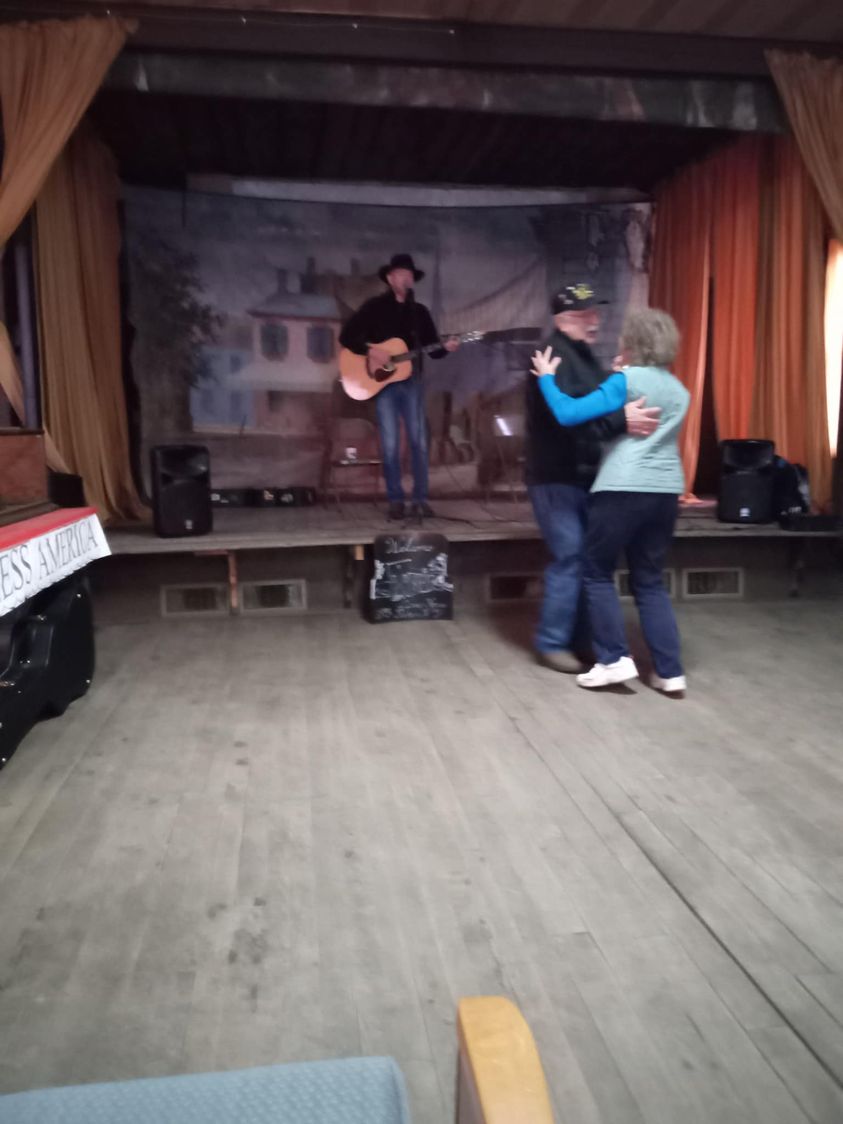
“Dance Me” is the song I’m playing in the out-of-focus photograph while the 85 year-old couple dances. It’s a highlight of my brief sojourn into the world of the performing artist. This happened this past weekend at the Pickens Opera House in Pickens, West Virginia during the Maple Syrup Festival. It may not be Red Rocks, but hey, they danced to my music. Or Leonard Cohen’s music, I guess. I played six songs in Pickens, four of which I wrote myself.
This morning I couldn’t sleep so at four o’clock I got up and came into the office. As I drove in, I was listening to the Avett Brothers song, “I Go to My Heart.” Scott Avett asks the question, “How do I stop this outro that I’m headed for?” Well, Scott, you don’t.
A couple of years ago, I couldn’t play an entire song on my guitar, which I’d had for more than thirty years. To progress to the point where I could write and play songs in front of people by myself is no small feat for this ever-aging man. Old dogs can learn new tricks.
In the two years I’ve been doing this, I’ve played at many venues. I was even one of the featured songwriters at the world famous Empty Glass in Charleston. Jason Isbell has played there. Parker Milsap has played there. Even the Avett Brothers. And now Joe Bird.
I didn’t know performing was a bucket list thing until now. I wrote a song recently about Joe Tyler Johnson, a poor soul who grew up in the mountains of Virginia. He became successful and moved to New York and traveled to France. All that glitters, you know. So he went back to Virginia to be with the love of his youth, but, alas, he was too late.
Joe Tyler Johnson just sits by her grave, wishing for yesterday, but it’s too late to pray.
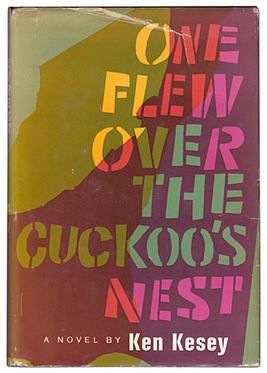
Want to know how to write a novel? Read One Flew Over the Cuckoo’s Nest, by Ken Kesey.
I saw the movie…40 years ago? I just read the book.
There’s so much to talk about. It’s a great book (but not without controversy) and another day we’ll get into what the book’s about.
If you’re a student of the craft of novel writing, you know the rules. And as you try hard to stick the rules, you see so many successful novels that break them. Cuckoo’s Next follows the rules. And is brilliant for it.
Plot Summary:
Randle McMurphy is serving a sentence at a prison work farm and gets himself committed to a mental hospital in hopes of doing his time in a cushier setting.
The Beginning:
McMurphy arrives at the hospital. No backstory. No set-up. No character development. No prologue, just story. In medias res. The way it’s supposed to be.
Point-of View:
The rules say to tell the story from one perspective. Yes, modern sensibilities allow for multiple points-of-view, but that approach is fraught with potential trouble. One point-of-view is the safe choice.
Cuckoo’s Nest is told from the point-of-view of mental patient, Chief Bromden, a Native-American. Everything is told from his perspective. If Chief doesn’t see it, we don’t see it. Chief can only surmise character motivations based on what he sees and what others may tell him. The author doesn’t jump around and tell us what the other characters are thinking. It’s all from Chief’s point of view. No omniscient narrator. And because we know what he thinks, we know much more about him than any other character.
The Protagonist:
McMurphy is the protagonist. That doesn’t mean he is the most virtuous character in the book. That’s probably Chief Bromden. McMurphy is the classic anti-hero. He’s not a good guy, but he’s very likable. And as he hustles his fellow patients, he does it in a way that lifts their spirits. Everybody loves him. Everybody but Nurse Ratched.
The Antagonist:
Sometimes the antagonist in a novel isn’t a person, but something keeping the protagonist from reaching his/her goal. McMurphy fighting the system? Well, yes, but the antagonist in Cuckoo’s Nest is not so amorphous. It’s Nurse Ratched. No doubt about it. One of the most unlikable characters I’ve ever met. She’s not evil in a Bond villain kind of way; she’s just cold and mean and against McMurphy in every way. The lines are drawn. The reader wants McMurphy to win. And Ratched to lose.
The Ending:
I’ve read that in classic literature, there is comedy and tragedy. The comedy isn’t necessarily funny; it’s prime characteristic is the happy ending. The tragedy is just the opposite.
Cuckoo’s Nest is a tragedy. The happy ending may give you a moment of contentment, but the tragedy stays with you, haunts you, makes you think. What might have been? What if McMurphy had won? What if Nurse Ratched had lost? Could it have made a difference for Billy Bibbit? And what of Chief Bromden? Did he ever make it home?
If you read this 50 year-old novel, you’ll be jarred by some references that are considered offensive today. But is it Kesey or his characters making the references? The characters, of course. They’re flawed. But does that give Kesey license to let them say what they do? We’ll get into that in more detail later. What Kesey does that’s indisputable is craft a story that takes you to the edge of realism at a pace that seems perfect. In the second half of the book, when the story rolls like a boulder down a mountain, he does nothing to get in the way. It’s a great example of plot and character development in perfect sync.
I’ve always read a lot. Maybe not voraciously, I’m too slow for that. But I’ve read a wide range of books. When I began writing, Joe Higginbotham gave me books. Books that he bought for the sole purpose of sending to me so that I could experience good writing.
He was a big fan of Kurt Vonnegut so he sent me some of his books. Slaughterhouse Five. Breakfast of Champions. Vonnegut is so different, so unique, it’s hard not to be influenced by his work.
He also introduced me to one of my favorite authors, Chris Offutt. Offutt is from eastern Kentucky, close to my neck of the woods, and his stories connect with me for that reason alone. There is also a simplicity and directness in his writing. The characters in his stories are not overly complex and their journeys are not epic, but they’re real people. Joe mailed me three of his books, The Good Brother, The Same River Twice, and No Heroes: A Memoir of Coming Home. I’m glad he did.
He encouraged me to be a better business person and said I should read Fierce Conversations, by Susan Scott, Never Eat Alone, by Keith Ferrazzi, and Selling the Invisible, by Harry Beckwith. I did. As well as many others that he recommended.
And the first book he said I should read – well, study really – was Louis Berkhof’s Systematic Theology. Heavy stuff, man.
But that was Joe. He knew what he was talking about and challenged you to be better. That’s a good friend.
 Joseph E Bird