Editor’s Note: This story was inspired by The Mystery Hole. I posted this a couple of years ago, but since we (meaning me) were talking about The Mystery Hole yesterday, I offer it again.
It’s important to understand that in this work of fiction, the main character is a woman, and the story is told from her perspective.
THERE’S A GORILLA ON THE ROOF. Really. And a Volkswagen Beetle sticking out of the side, looking very much like an unfortunate accident. I almost turned around without stopping.
.
When you watch your husband slowly dying over the course of the year, you think you’re ready. You’re not ready. You know your life is going to change. You have no idea.
.
It’s called The Enigma. It’s so far out of the way, that it’s almost impossible to find by happenstance. So yes, I actually planned the trip. But everything else was, maybe, serendipitous.
I met Kendall fifteen years ago in New York. I met a lot of young doctors back then. I was still working directly with clients and it was such an incredible time to be young and rich. And it was easy to be a broker. Money begat money.
Kendall had been referred to me by the Chief of Oncology at Sloan-Kettering. How’s that for irony? These days everything can be handled over the Internet, but back then, it was still the norm to meet in person. Face to face. No time to be personal now.
My family moved to the U.S. when I was very young. My father was a chemical engineer, my mother an architect. My first year in college, they divorced and Mother returned to China. I don’t know if they ever loved each other but this much I know: Mother loved her homeland; Father wanted more than anything to be a successful American. When I graduated from Princeton he moved to California. He says he is happy.
Three years ago my brokerage house offered me the position of Vice President of the Appalachian Region. Serving as a Regional Vice President is a prerequisite to a Senior Vice President position and the more challenging the Regional position, the greater the reward. There is no greater challenge than the cash-poor Appalachian Region. I was well-respected at the firm. I was pleased to have been challenged so.
As peculiar as The Enigma is on the outside, it is even more bizarre inside. It is difficult to describe. Nothing is what it appears to be. Gravity is mocked. A plumb-bob hangs at an angle at least thirty degrees from perpendicular. We walked across a floor so askew that we certainly should have fallen – yet our balance was sure. And when we entered a room that appeared to be completely normal, I experienced a touch of vertigo. I took two small steps sideways and instinctively my left hand reached out. I clutched the forearm of Rembrandt Morgan.
I remember that first meeting with Kendall distinctly. It was the first time in my life that I had met someone with such intense blue eyes. Mother had told me years before that men with blue eyes were destined to accomplish great things – but not necessarily great good. My first emotion associated with Kendall was fear. He flirted unabashedly as I tried to discuss investment options. I knew many American men had an attraction to Asian women, so I was suspicious anyway, but those eyes were beautifully scary.
Had Rembrandt Morgan’s eyes been brown, he would have simply been another forgotten face. Of course they were blue.
Father had worked in Charleston for two years while I attended university. At the time it was a center for chemical production and Father had engineered new techniques for the production of silicones. He said the mountains of West Virginia reminded him of the Yangtze province. I used to wonder if Mother would have stayed longer had she seen the mountains. I no longer wonder.
When I first moved here, I hated it. Nobody lived in the city. Not that there was much of a city anyway. Kendall and I bought a house in a suburb thirty miles away that had no mountains at all. We lived beside a river just upstream from a coal-burning electric plant. As we drove into Charleston every day, we passed chemical plants, junkyards and strip clubs. On a good day, it was tolerable. Summer was the worst. Heat inversions stagnated the atmosphere and every putrid odor furtively emitted the night before by the chemical plants seemed to soak through our clothes and ooze into our pores. But we knew it would be temporary. We knew we would eventually return to New York.
As I clutched the forearm of Rembrandt Morgan, he looked down at me and smiled and asked if I was all right. His breath was sweet and musky. Had I known why, I don’t know how I might have reacted. It wasn’t until later that day that I learned the truth. By that time, I had already kissed him.
All of the houses in our development were large, beautiful, and isolationist. Very small front porches were merely architectural adornments; no one ever used front doors. We came and went from our brick fortress with barely a nod or a wave to those whom we lived among. It was not that different in New York, really, but somehow New York felt right.
Last year on a sticky summer evening, Kendall and I attended the dedication of a new sculpture at the arts center. In Charleston, a new sculpture is a major cultural event. Our friends, Nathan and Orillia Laurie, had commissioned a New York artist to create a bronze interpretation of a young King David and his lyre. The result was a wonderfully abstract expression that captured the essence of the spirit of King David’s love of music. Unfortunately, King David’s essence did not include a recognizable human figure.
The following day the newspapers recorded the public dismay and lack of appreciation. It created an unbelievable debate about Nathan’s artistic values and his elitist sensibilities that lasted for weeks, during which Nathan remained silent. When he could take no more, he wrote a letter to the editor and suggested that West Virginia’s taste is better suited to hubcap art and the cultural aesthetics of The Enigma.
The day the letter appeared, we celebrated with Nathan and Orillia at one of the few nice restaurants in town. It had been a wonderful evening, full of delightful spite, until Kendall became dizzy driving home. I believe he knew that night what his future held.
As we began our excursion, a young couple exchanged uncomfortable glances and unfamiliar touches, no doubt trying to be spontaneously fun in the middle of their honeymoon at the nearby state park. They couldn’t have made a poorer decision. Rembrandt, it turns out, was there to secure advertising for the Roland County Weekly Advertiser. We continued our tour together, and unlike the couple who knew each other carnally, our glances were comfortable, our touches familiar.
The second room we entered had two windows side by side. One was out of square. I couldn’t tell which one. In the middle of the room was a table and chairs and along the wall, more chairs. The guide motioned for me to sit at the table. Rembrandt followed. The uneasy couple took a seat along the wall. I tried to sit but couldn’t find my balance; I kept sliding off to one side. Rembrandt steadied me. His arm was tattooed with a poor rendering of a deer. His skin was warm.
Kendall had developed a tumor on his brain. Inoperable, of course. He took the chemotherapy not to save his life, but to simply prolong it. He did it for me. He wanted me to ready myself for his death. Four months. Four years. It doesn’t matter. Four days would have been the same.
I miss Kendall. I miss Mother. I miss Father. I miss New York.
The guide led the group through the back door and on to the souvenir shop. I stopped, pausing in the room that defied logic and looked at Rembrandt. He closed the door and took my hands, held them next to my face and kissed me.
Two weeks before he died, I was named a Senior Vice President. I will move back to New York, but now I am on sabbatical. It will be at least another month. Maybe more.
Rembrandt had no way of knowing my circumstances. No way of knowing my vulnerability. No way of knowing that I wouldn’t slap him or knee him in the groin. No way of knowing that I would return his kiss.
We spent a few minutes in the gift shop. I bought an Enigma bumper sticker that now adorns my Volvo’s rear bumper. Then Remmie asked me to join him for a cup of coffee. I followed him up the winding mountain road, expecting a trendy coffee bar tucked away in the hills. Instead, he pulled his black pick-up into a gravel lot of the Hawk’s Nest Diner. No cappuccinos, no lattes. Just black coffee. And a slice of apple pie. We talked for more than an hour.
Remmie is an artist. Some of his paintings were on display in the diner. He has an incredible sense of composition and color, a gift, he told me, that he got from his grandmother. Quite remarkable.
He also hunts. And works for the weekly advertising paper. He was married once, but his wife ran off with a Charleston lawyer. Which is why he drinks. Remmie has never been outside of West Virginia.
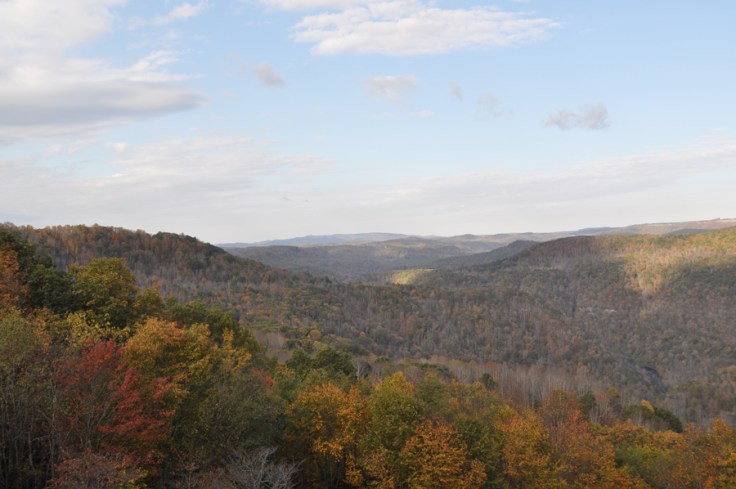
I drove past The Enigma on my way back down the mountain, one of Remmie’s paintings on the back seat. It saddened me to know that I would not see Rembrandt Morgan again. I would not see Kendall again. I would not see this mountain again. I thought about Mother, wondering if her homeland were as beautiful as the scene in Remmie’s painting. I wondered if Mother had felt similar feelings in leaving Father. I wondered why she had to leave. I wondered why I had to leave.
In my rear-view mirror, the gorilla seemed to be waving.
copyright 2014, joseph e bird


 Joseph E Bird