If it is important to you, you will find a way.
If not, you will find an excuse.
— Ryan Blair
If it is important to you, you will find a way.
If not, you will find an excuse.
— Ryan Blair
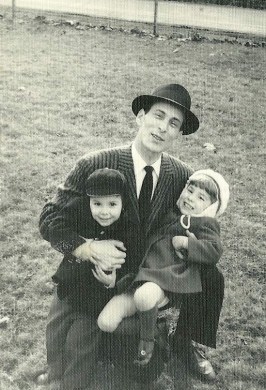
Most are not leaders of nations.
Most are not creators of wealth.
Most are not icons of art.
Their names will not be written in the annals of history.
But without them, we would be nothing.
Their fathers worked with pride as pipe-fitters and welders and electricians.
Their fathers mined coal and dug ditches and toiled with dignity.
They did what was necessary to provide food and shelter and clothes.
They did what was necessary to provide hope for a better tomorrow.
Tomorrow came, and it was better,
and the sons and daughters of the fathers went to school
and became teachers and writers and lawyers and engineers.
They became fathers and mothers themselves
and likewise provided for their families.
They did all of this without the need for attention,
without the need for adulation,
without the need for self-aggrandizement.
Fathers persevere and sacrifice.
They do what needs to be done.
They are good and honorable.
No, not all fathers.
Some abandon.
Some abuse.
Some give up.
It’s not about gender roles.
Sometimes the mother is the father.
Sometimes she is both.
It’s not about being the breadwinner.
It’s about being strong for the family.
It’s about providing direction to those who wander
and encouragement to those who strive.
Now they rest,
their work less strenuous,
their lives less demanding,
and they sit quietly,
content to let others lead.
They have lived simply.
They have lived nobly.
They have given their all.
They are our fathers.
copyright 2019, joseph e bird
On the first day of winter he awoke and stood at his window and looked out on his fields wet with rain. It had taken him longer this year to clean the banks and hillsides. He no longer went at tasks to finish them in one day. Now he worked as time and strength allowed […]
It’s been described as having ALS (Lou Gehrig’s disease), Parkinson’s, and Alzheimer’s simultaneously. There is no cure and the disease is fatal.
According to the Huntington’s Disease Society of America, there are currently 30,000 symptomatic Americans. That’s less than 0.01 percent of the population. But if you or a loved-one has Huntington’s, that’s a meaningless statistic.
My family has no first-hand experience with Huntington’s. The wife of a former associate pastor at our church was my introduction to the illness. When they came to our church, she was in the middle-to-late stages of the disease. She was still able to walk and engage in conversation, though it was sometimes difficult to understand what she was saying. Her symptoms at the time included chorea – involuntary and unpredictable body movements that affected her upper body, arms, and face. Over the course of a few short years, her symptoms worsened. Soon she was unable to walk and required a wheelchair. Then a nursing home. After a year or so there, she passed away peacefully.
She was fortunate in that she had a husband who loved her unconditionally and was by her side until the end. I don’t really know what his life was like as the primary caregiver, but I have no doubt that it was unimaginably challenging on so many levels. He leaned on his faith, as did she, with the knowledge that though in this life she was broken, in the next she would be made whole.
In my novel Heather Girl, Heather Roth has Huntington’s Disease. I didn’t start out to write a novel about someone with Huntington’s. My intent was to tell the story of a young woman with challenges, one of which was how she was dealing with a serious health issue. As the story unfolded, I learned that Heather’s mother had Huntington’s. It’s hereditary. If one of your parent’s had Huntington’s, there’s a 50-50 chance that you will have it. As my story begins, Heather is becoming symptomatic. And she knows where it leads. There are other complications in her life and because her family is fractured, she doesn’t have the best support system. She doesn’t always act reasonably and her decisions are not always the best. But this story is fiction.
In real life, the effects of Huntington’s, like the disease itself, are varied. Some, like the wife of our pastor, have love and support all the way. For others, it’s a long, lonely journey. If you know a family living with Huntington’s, you can be a friend. Little things can help. A Frosty from Wendy’s is always a treat and good for those with difficulty swallowing. A bowl of soup for caregivers on a cold, winter’s day will mean more than you realize. And a sympathetic ear is always appreciated.
Even if you have perfect health – and nobody I know has perfect health – life can be hard. Be a friend, lend a hand, and help someone find hope in the compassion that we can all offer.
New York, September 11, 2001.
It was journalistic instinct that pulled Richard Drew to the Twin Towers when everyone else was running away. The veteran photographer did what he always did – take pictures. And from the scores of photographs he took that day came the iconic image that would become known as The Falling Man.
It’s a disturbing image that is seldom published. I know of it because of an article I came across in Esquire Magazine by Tom Junod. Journalism at its best, even when capturing the most horrific scene you would never want to imagine.
The photograph is an anomaly, one frame of many in a sequence that shows the true horror suffered by dozens of victims forced to choose how they were to die on that sunny September morning. The person in this particular photograph appears calm, accepting his fate. An anomaly of a single click of the shutter.
The photograph is also an accident in symmetry. The Falling Man is vertical, in line with the architectural lines of the Towers. To his left, the North Tower, to his right, the South Tower.
It’s a controversial image, the discussion of which can quickly devolve into a bitter geopolitical debate. Some think the photograph should never be published. I understand that. Some will say that Tom Junod’s article doesn’t tell the whole story. Of course it doesn’t. How you feel about the photograph, how you feel about the story, is your business.
But you will feel something. You will feel something very strongly.
It’s the power of photographs. It’s the power of words.
https://www.esquire.com/news-politics/a48031/the-falling-man-tom-junod/
In my novel Heather Girl, there is a photographer, Avery Graham, who specializes in capturing the true essence of a person through real-life, gritty portraits.
Meet Kimo Williams, an accomplished musician, photographer, and Vietnam vet. We like to say everyone has a story to tell, but in the case of Kimo Williams, I’m sure it’s true. Probably many stories to tell.
Though his background is different than Avery Graham’s, their photography work is similar. (Yes, I know Avery Graham’s photographs exist only in my imagination, but they’re very vivid to me.)
Despite being part of a brutal and horrific war, Kimo Williams was able to find beauty in Vietnam. It’s what drew him back many years after the war had ended. His photographs of the people of Vietnam, from his original tour of duty and his return trips, are featured in an exhibit he calls Faces of Vietnam at his studio in Shepherdstown, West Virginia. There are lots of smiling people – kids and adults – but I’m drawn to those who aren’t smiling, those who seem to have something on their minds. Like they know something. Like they have a story to tell.
See for yourself.
Here’s the link to an article in the Sunday Gazette-Mail.
Here’s the link to his website, KimoPics.
 An unusual church, perched high on a hill overlooking the small town Ronceverte, West Virginia.
 The potential: Ronceverte’s version of New York’s High Line Park.

A hundred steps to nowhere.
I was at a conference last week and ran into a friend who knew I was a writer and he asked what I was working on. I told him I was putting the final touches on my novel Heather Girl.
“What’s it about?”
“Well,” I said, “it’s about a middle-aged woman who is fighting Huntington’s disease and she just learned that her father has been paroled for the murder of her mother.” As I was saying those words, I realized that it was not a very compelling summary of my novel. Yes, that’s what it’s about, but why would anybody want to read such an obvious bummer ?
“Yeah,” I said, “it’s a real feel-good story.”
I failed my elevator speech. I realized I needed a better way to summarize the story. How about this?
As her family falls apart and her health begins to fail, Heather Roth searches for answers, but instead finds hope and compassion that give her life meaning.
Ok, so it’s still not going to fly off the shelves like a James Patterson novel, but at least it’s not so ridiculously bleak.
Then, if they want to know more, there’s the cover blurb:
Heather Roth has little to look forward to. Her two sons, who have occupied most of her adult life, have grown and left her alone in the house in which she grew up. Her ex-husband, for whom she still has feelings despite his abusive nature, lives hundreds of miles away. And she’s being treated for Huntington’s, a disease that ravaged her mother, and for which she knows there is no cure.
Then the news she wasn’t expecting. Her father is being paroled from prison in Texas where he has been serving a sentence for the murder of his wife, Heather’s mother.
She’ll do anything to keep him out of her life, but when she is forced to take him into her home, she learns that the lives of her family weren’t what they seemed to be. A story of tragedy and heartbreak, Heather Girl, delivers a whisper of hope and an abundance of compassion, even in the darkest hours.
“For through wisdom your days will be many,
and years will be added to your life.”
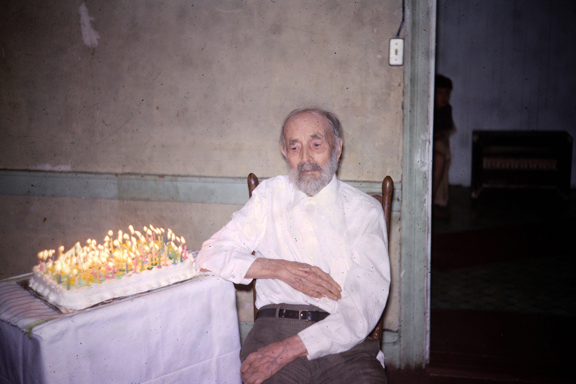
The photo is of A. S. “Sid” Morgan, maybe taken in 1973, maybe his 90th birthday. I suppose I could try to count the candles. If it was 1973, he would die less than a month later.
This is the kind of photograph that inspires stories, spurs the imagination of a writer. But Sid lived the adventures. He built boats and floated down the Mississippi on hunting expeditions back in the early 1900s. In 1926, he opened a museum that over the years became legendary.
You’d never guess he lived that kind of life from the picture. He looks tired. The house he’s in, once a proud mansion on the bottom land near the Kanawha River, looks tired. I was in the house many times as a child and the memories are still strong. Unusual memories. The smell of the soft, slowly decaying wood of the front porch, patches of tin covering the holes. The feel of the air in the house. Cool, until you walked into the kitchen and the gas heaters overwhelmed with stuffy warmth and lingering fumes. And the quiet. Sometimes the house was full of people, full of kids, but I remember the times where it was only Mom and Sid, our family visiting quietly, the stillness of it all unsettling.
It’s gone now. The house demolished shortly after Sid’s death. Across from where the house sat is the massive John Amos Power Plant. No hint of what happened there years ago.
But the stories are still there, just waiting to be written.
 Joseph E Bird